 Powered by Bioz
FabRICATOR®
Download Product Folder


FabRICATOR (IdeS) is an IgG-specific cysteine protease that digests antibodies at a single amino acid site below the hinge, generating homogenous F(ab’)2 and Fc fragments.

SmartEnzymes™
FabRICATOR is widely used in characterization, quality control, stability testing, production monitoring and clone selection of antibody-based therapeutics such as mAbs, ADCs, biosimilars and Fc-fusion proteins.
Download Product Folder
Human IgG1-4, IgG of some classes from monkey, rat, rabbit and sheep
30 min reaction
No need for reducing agents or co-factors
CPAPELLG / GPSVF (below the hinge)

Immobilized enzyme for below hinge digestion of IgG in spin columns
Buy product
Immobilized enzyme and affinity resin for below hinge digestion of IgG and purification of fragments
Buy product
Immobilized enzyme on magnetic beads for automated digestion of IgG below the hinge
Buy product
Lyophilized enzyme with low levels of endotoxin for below hinge digestion of IgG
Buy product
Three different lyophilized batches for validation of FabRICATOR-based analytical methods
Buy product
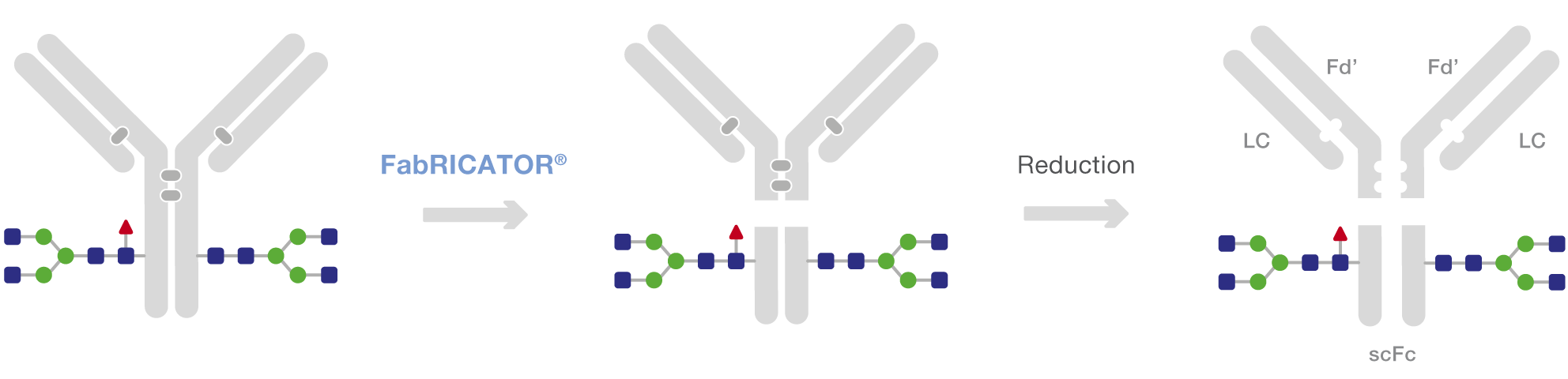
FabRICATOR (IdeS) is a unique enzyme that digests IgG at a specific site below the hinge region, generating a homogenous pool of F(ab’)2 and Fc/2 fragments.
No other substrate besides IgG is known. The IgG is digested within 30 minutes, and there is no risk of overdigestion if the incubation time is prolonged. Since FabRICATOR digests IgG under physiological reaction conditions, the immunoreactivity is preserved. The best activity is obtained at 37°C, but digestion can also be performed at room temperature using a prolonged reaction time.
FabRICATOR digests all subclasses of human and some classes of monkey, rabbit and sheep IgG. It has limited activity on mouse IgG2a and IgG3 – for digestion of these antibody species, we recommend using FabRICATOR Z.
FabRICATOR is cloned from Streptococcus pyogenes and recombinantly expressed in E. coli. It is produced by Genovis AB for analytical and biotech applications requiring the highest standards and consistency. The enzyme contains a His-tag and has a molecular weight of 38 kDa.
A method to detect the FabRICATOR enzyme is available. Learn more about Anti-FabRICATOR, a goat polyclonal antibody.
Fast and reliable middle-level analysis of antibody oxidation using FabRICATOR and GlycINATOR, supporting robust QC of critical quality attributes.
Generation and purification of F(ab’)2 and scFc fragments without residual enzyme, enabling rapid preparation of antibody fragments for downstream applications.
Generation of defined IgG subunits via single-site, below hinge cdigestion, enabling high-resolution middle-level LC-MS and improved PTM characterization.
Watch video
Download Scientific Poster

Download Application Notes

Download Application Notes

Download Application Notes

Download Scientific Poster

Dan Bach Kristensen
Symphogen A/S

Yury Tsybin
Spectroswiss

Min Kyung So
KBIO Osong Medical Innovation Foundation

Genovis has chosen CaptureSelect in the FabRICATOR Fab2 Kit for removal of Fc fragments. CaptureSelect has a very high specific affinity for the Fc. Both protein A and MabSelect Sure (GE) may have affinity for the Fab which may result in a lower recovery of the generated F(ab’)2 fragments and the degree of affinity is antibody dependent. We have many customer reports on this subject, and they usually come back to us for the CaptureSelect columns for the above reason.
FabRICATOR is a cysteine protease. It should not result in any other modifications than the digestion of the peptide bond. Digestion will be between the two Glycines (…CPAPELLG / GPSVF…) and the C-terminus will regain the carboxyl group – that is addition of one OH-group and the N-terminal amino group will be regained (addition of one H).
In summary, R1-CO-NH-R2 + H2O –> R1-COOH + NH2-R2.
It is possible to use FabRICATOR with low concentrations of IgG. Low concentrations of IgG will lead to decreased reaction rate, so for concentrations below 0.5mg/mL it is therefore recommended to increase the amount of added enzyme and/or increase the incubation time. There is no risk of over-digestion and the incubation time can be prolonged to O/N if necessary.
FabRICATOR Fab2 Kit digests rabbit IgG but to capture the Fc fragments in the affinity step you need another resin than the CaptureSelect™ Fc normally included in the kit. Please contact the Genovis team if you are interested in processing rabbit IgG and we will provide columns with resin compatible with rabbit Fc in the FabRICATOR Fab2 Kit.
Yes, PNGaseF and FabRICATOR can be used in a one-pot reaction as long as the reaction conditions follow the specifications for the FabRICATOR enzyme. It is important to have native reaction conditions for FabRICATOR to remain active.
All rights reserved. Genovis products may be covered by one or more patents, trademarks and copyrights owned by Genovis AB or licensed from third parties. For more information about commercial rights, please contact the Genovis team at licensing@genovis.com.
Genovis products are intended for research use only. They are not intended to be used for therapeutic or diagnostic purposes in humans or animals. All goods and services are sold subject to Genovis’ General Terms and Conditions of Sale.
© Genovis AB