
Sialic Acid Removal for Improved Charge Variant Analysis using SialEXO™
Application
Simplified charge variant analysis by removing sialic acid-driven heterogeneity to reveal underlying protein profile.

Charge variant analysis is used to characterize protein isoforms arising from post-translational modifications, with sialylation often contributing significantly to charge heterogeneity. Enzymatic removal of sialic acid can simplify charge profiles, improving resolution and interpretability of charge variant analysis to better assess underlying product quality attributes.
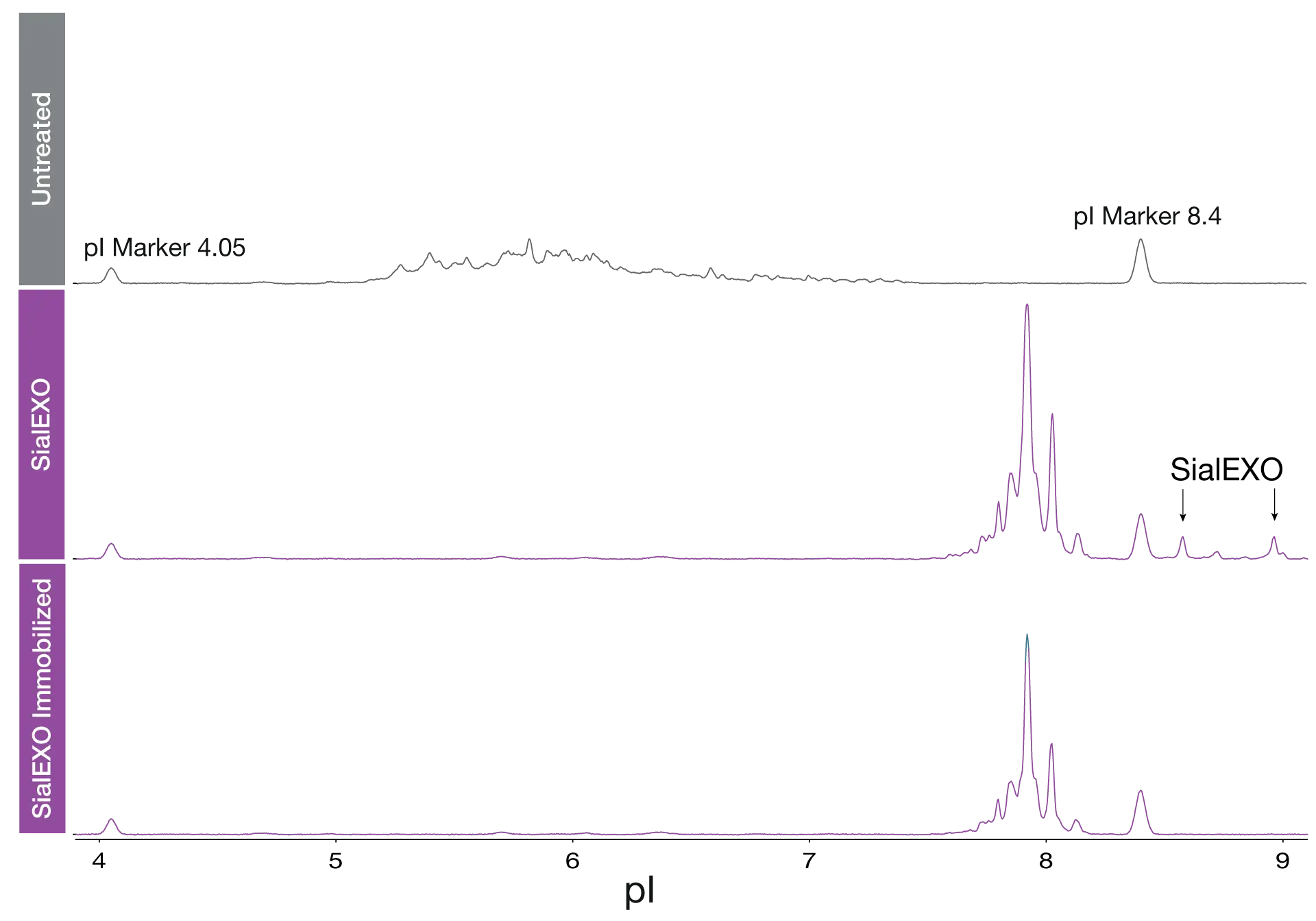
In this example we are using etanercept which is an Fc-fusion protein made up of an Fc-domain from a human IgG1 and the TNFα receptor (TNFR). Etanercept contains 3 sites of N-linked glycosylation and up to 13 sites of O-linked glycosylation on each half of the molecule with high levels of sialylation observed. Because sialic acid is a negatively charged monosaccharide, high levels of sialylation makes analysis using charge variant analysis very difficult, and sometimes, no usable data can be generated without prior sample preparation. Using the Maurice instrument from ProteinSimple, we performed icIEF analysis on native, intact etanercept, as well as etanercept which had been desialylated with either SialEXO Lyophilized or SialEXO Immobilized. The electropherogram for the native, intact etanercept is poorly resolved there is such a high degree of charge heterogeneity, predominantly driven by the presence of high levels of sialylated glycans, we cannot get any usable or interpretable data from this sample.
Poor resolution and lack of interpretable data when analysing intact etanercept by icIEF
To reduce this heterogeneity, we hydrolyzed the sialic acids by incubating with either SialEXO Lyophilized or SialEXO Immobilized. Once the sialic acid-derived charge heterogeneity was removed, the underlying protein charge variant profile was uncovered. By efficiently removing the sialic acids we can focus on the characterization and monitoring of the protein charge variants.
Removal of sialic acids enables charge variant characterization of protein components
Both SialEXO Lyophilized and SialEXO Immobilized remove sialic acids with the same high efficiency, however, when we compare the electropherograms, we can confirm that when using SialEXO Immobilized, there is no residual enzyme remaining in the final sample, which can be observed in the SialEXO Lyophilized treated sample. In this instance, the presence of residual enzyme does not interfere with the analysis, however, it could be detrimental if the analyte molecule has a higher pI. SialEXO Immobilized is, therefore, particularly ideal for applications where clean samples are desired, which is of particular importance when functional or structural characterization methods are performed.
No enzyme in the final sample when using SialEXO Immobilized
Related Products


Resources
SialEXO™
Download Product Folder

SialEXO™ for Complete and Rapid Desialylation of Therapeutic Glycoproteins
Download Scientific Poster


