 Powered by Bioz
OmniGLYZOR®
Download Product Folder

OmniGLYZOR contains a mixture of immobilized enzymes for fast and efficient removal of N- and simple mucin-type O-glycans on antibodies, fusion proteins and other glycosylated proteins.

SmartEnzymes™
Its broad enzymatic specificity makes OmniGLYZOR well suited for streamlined sample preparation in analytical workflows where robust and reproducible deglycosylation of highly complex protein substrates is desired.
Removal of glycans is widely used to reduce heterogeneity to facilitate analysis of the protein by for example mass spectrometry. Deglycosylation can also be used to study the functional role of the glycans.
Download Product Folder
N- and simple mucin-type O-glycans on glycoproteins
1-4 hour reaction
RapiGest™* SF and PNGase F Lyophilized are included
Hydrolysis of N- and simple mucin-type O-glycans, including Tn antigen
A mix of immobilized enzymes in spin columns for deglycosylation of glycoproteins carrying N- and simple O-glycans
Buy product
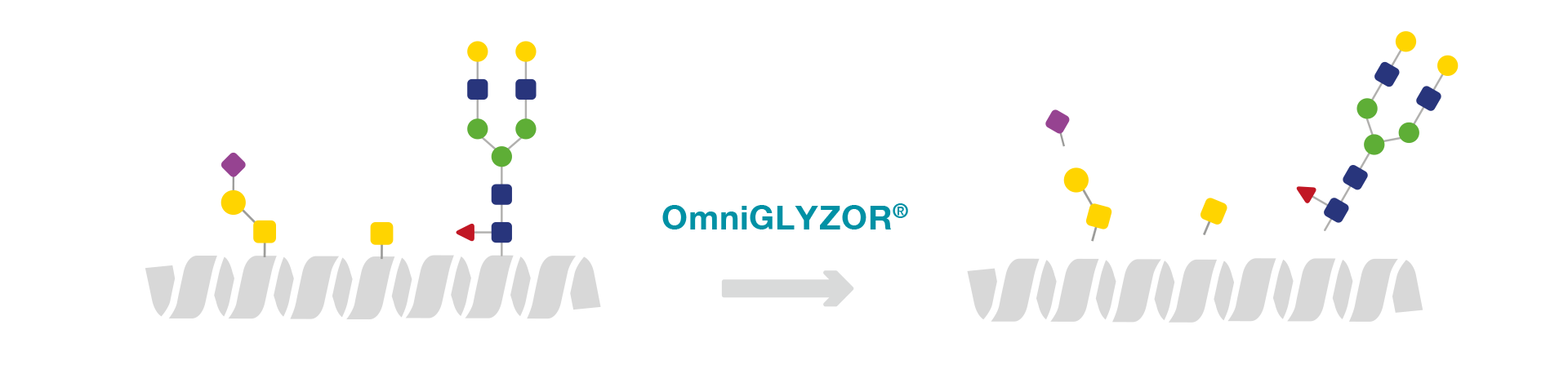
OmniGLYZOR contains enzymes required for the removal of N-glycans and the most commonly occurring mucin-type O-glycans, namely mono- and disialyl core 1 and Tn antigen (α-GalNAc).
The following activities are included in an OmniGLYZOR Immobilized Microspin column:
The glycoprotein sample is incubated with the OmniGLYZOR resin in a microspin column for 1-4 h under native reaction conditions. The deglycosylated glycoprotein is then easily collected by a centrifugation step.
Removal of N- and O-glycans from complex and heavily glycosylated proteins, enables clear, interpretable LC-MS analysis.
Native removal of O-glycans and removal of inaccessible N-glycans under denaturing conditions, enables complete glycan analysis of the complex C1-inhibitor
OmniGLYZOR hydrolyzes the amide bond between the polypeptide asparagine and the innermost GlcNAc of all mammalian asparagine-linked complex, hybrid, or high mannose oligosaccharides. It does not remove N-glycans with α1-3 core fucosylation.
No, both N- and O-glycans are trimmed by the exoglycosidases present in OmniGLYZOR and do not longer represent the structures found on the intact glycoprotein substrate.
No, it is not recommended. We can only guarantee optimal performance for one-time use.
All rights reserved. Genovis products may be covered by one or more patents, trademarks and copyrights owned by Genovis AB or licensed from third parties. For more information about commercial rights, please contact the Genovis team at licensing@genovis.com.
Genovis products are intended for research use only. They are not intended to be used for therapeutic or diagnostic purposes in humans or animals. All goods and services are sold subject to Genovis’ General Terms and Conditions of Sale.
© Genovis AB