
KRysin™ Is Now Available: Presenting New Plasma Proteomics and Phosphoproteomics Data at HUPO 2026
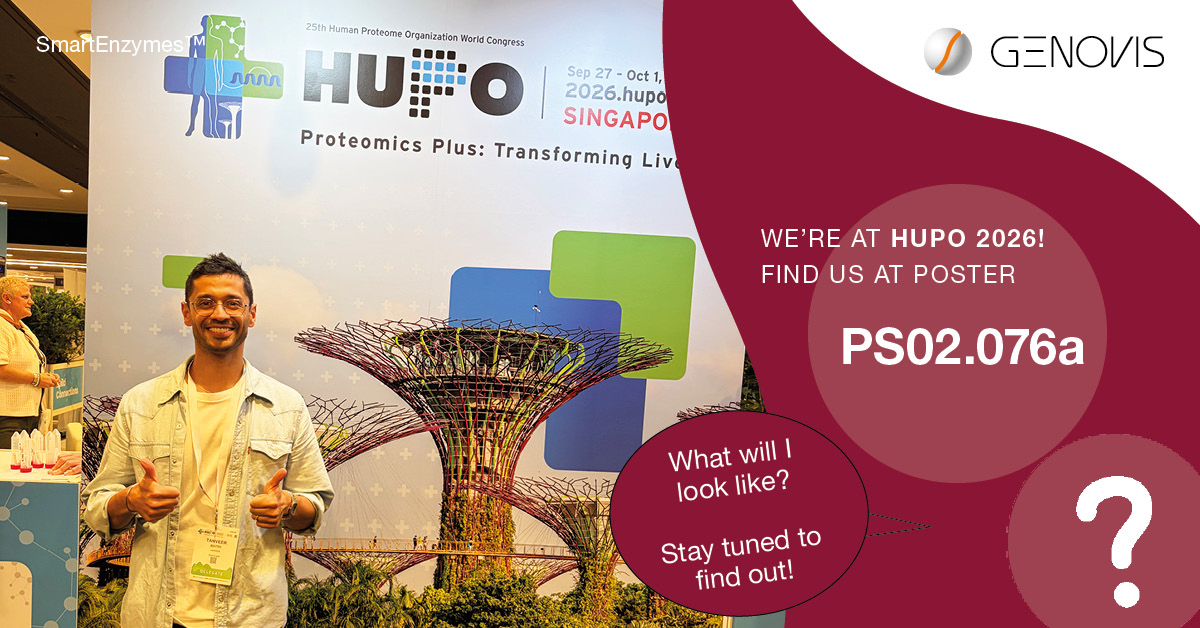
This week, Genovis is at HUPO 2026 in Singapore, where Tanveer Batth presents new data on KRysin, a high-fidelity protease for bottom-up proteomics. KRysin is available to order from today – scroll down to learn more about how to order 👇!
Why Digestion Quality Matters
Efficient enzymatic digestion is the foundation of any bottom-up proteomics workflow. Trypsin-based workflows are still limited by missed cleavages in challenging samples. Blood plasma is one of the most demanding matrices, and modifications, such as phosphorylation, located close to lysine or arginine residues can hinder cleavage. The result is long, missed-cleaved phosphopeptides that are hard to characterize.
KRysin generates tryptic peptides with the same arginine and lysine C-terminal specificity as trypsin, but with a much more complete digest. In the poster, KRysin was benchmarked against Trypsin and Trypsin/LysC for plasma proteomics and phosphoproteomics.
More Complete Digests, Across Workflows
In human platelet-poor plasma, 97% of unique peptides generated with KRysin had no missed cleavages. The corresponding figures were 82% with Trypsin/LysC and 69% with Trypsin. This efficiency held across direct in-solution, PAC and urea-based sample preparation, and across digestion times from 1 to 18 hours.
Deeper Plasma Proteome Coverage
Samples were analyzed by nDIA on a Thermo Fisher Orbitrap Astral mass spectrometer coupled to an Evosep One. KRysin identified the most plasma protein groups at every throughput tested, from 60 to 500 samples per day. At 60 samples per day, it reached 903 protein groups.
Many of the protein groups identified only with KRysin sit at the low end of the abundance range. Their median abundance was roughly two orders of magnitude below that of proteins shared with Trypsin/LysC. They include biologically important receptors, adhesion molecules, cytokines, chemokines and growth factors such as TGFB1, CCL5, ICAM1, MET and KIT. These proteins are not consistently captured when using conventional digestion approaches.
Expanded Phosphoproteome Coverage
In HeLa protein extracts, KRysin identified 49,888 class 1 phosphosites, compared with 39,158 for Trypsin/LysC and 38,125 for Trypsin, an increase of more than 27%. The gains held across serine, threonine and tyrosine sites.
KRysin also produced more fully cleaved phosphopeptides (80% vs 58% and 51%) and captured more multiply phosphorylated peptides. Sites that KRysin detected but Trypsin/LysC missed were enriched for nearby lysine and arginine residues. Salt bridges can form between the negatively charged phosphate group and these basic residues, and are known to block trypsin cleavage. KRysin therefore gives access to parts of the phosphoproteome that are difficult to reach with trypsin-based digestion.
Meet Us At HUPO 2026
PS02.076a: High-Fidelity Protease KRysin for Comprehensive Analysis of Plasma Proteomes and Post-Translational Modifications
Poster Session 2, Tuesday, September 29, 2026, 1:15–3:00 PM, Exhibit Hall
Authors: Tanveer S. Batth, Cristina Hernandez-Rollan, Claire Koenig and Jesper V. Olsen (KPL ApS, Genovis AB, and Novo Nordisk Foundation Center for Protein Research, Department of Cellular and Molecular Medicine, University of Copenhagen)
How To Order
KRysin is available now! To order, email us and quote the product code below, together with the amount.
KRysin™ Lyophilized, 20 μg: B0-KR1-020
For Europe, Asia and ROW: Email us at order@genovis.com
For US and Canada: Email us at orders.us@genovis.com
For questions about the product or applications, contact Philip Widdowson.