High Digestion Efficiency of hIgG1 using TrypsINATOR™
Performance Activity
Efficient digestion with minimal missed cleavages and high sequence coverage resulting in efficient peptide mapping and confident protein characterization.

High digestion efficiency is critical for reliable peptide mapping of antibody candidates and other proteins in drug development. Trypsin is routinely used for peptide mapping to confirm primary sequence, identify post-translational modifications (PTMs), and monitor product quality throughout development and manufacturing. High and consistent proteolytic digestion is important to minimize missed cleavages and ensure reproducibility, which is essential for confident identification of critical quality attributes (CQAs) and PTMs, comparability studies and regulatory submissions.
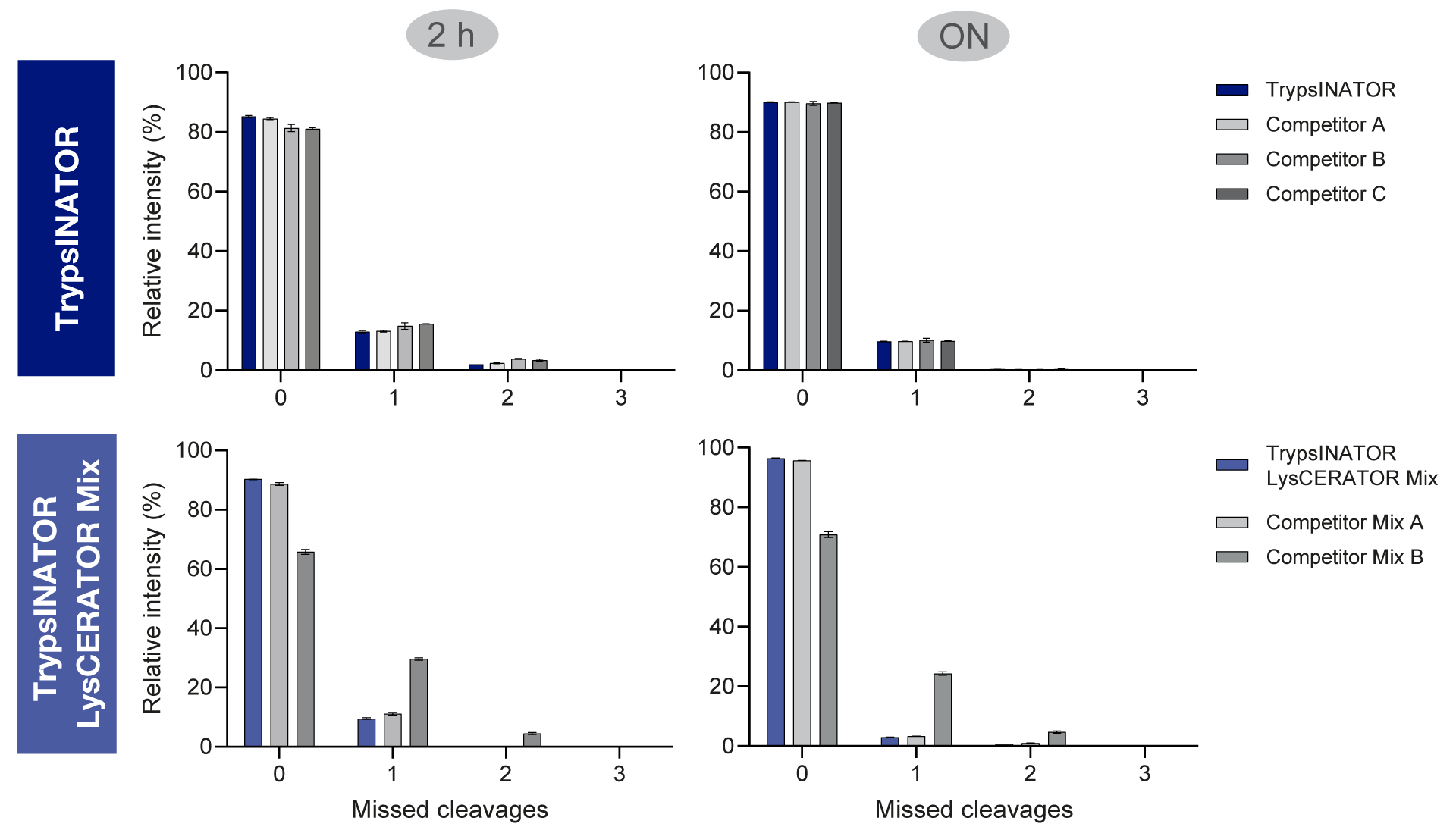
To evaluate the performance of TrypsINATOR for peptide mapping of antibody candidates, the human IgG1 trastuzumab was digested using TrypsINATOR and three commercially available trypsin products. Following a 2-hour digestion, TrypsINATOR displayed higher cleavage efficiency with 85% of total peptide intensity corresponding to peptides with zero missed cleavages compared to 81-84% for the other trypsin products. Following overnight digestion, all variants displayed similar efficiencies (90% zero missed cleavages) (Fig. 1a). The overall low standard deviation of the data demonstrates the robustness of the digestions.
Higher digestion efficiency of hIgG1 in a shorter incubation time compared to alternative trypsin products
Lys-C is commonly added to trypsin to create enzyme mixes with the same amino acid specificity as trypsin, aiming for a higher digestion efficiency than that of trypsin alone. To evaluate the performance of TrypsINATOR LysCERATOR Mix for peptide mapping of antibody candidates, the human IgG1 trastuzumab was digested using TrypsINATOR LysCERATOR Mix and two commercially available Trypsin/Lys-C mixes. Following a 2-hour digestion, TrypsINATOR LysCERATOR Mix displayed similar cleavage efficiency to competitor mix A with 90% and 89% of total peptide intensity corresponding to peptides with zero missed cleavages, respectively, and a considerably higher efficiency than competitor mix B (66% zero missed cleavages). The corresponding trend was observed after overnight digestion where the proportion of peptides with zero missed cleavages increased to 96% for both TrypsINATOR LysCERATOR Mix and competitor mix A, superior to competitor mix B (71% zero missed cleavages) (Fig. 1b). In addition, the data confirm that the digestion efficiency of TrypsINATOR alone is enhanced by the addition of LysCERATOR (from 85% to 90% peptides with zero missed cleavages after a 2-hour incubation and from 90% to 96% following overnight incubation).
Addition of Lys-C boosts digestion efficiency in the TrypsINATOR LysCERATOR Mix
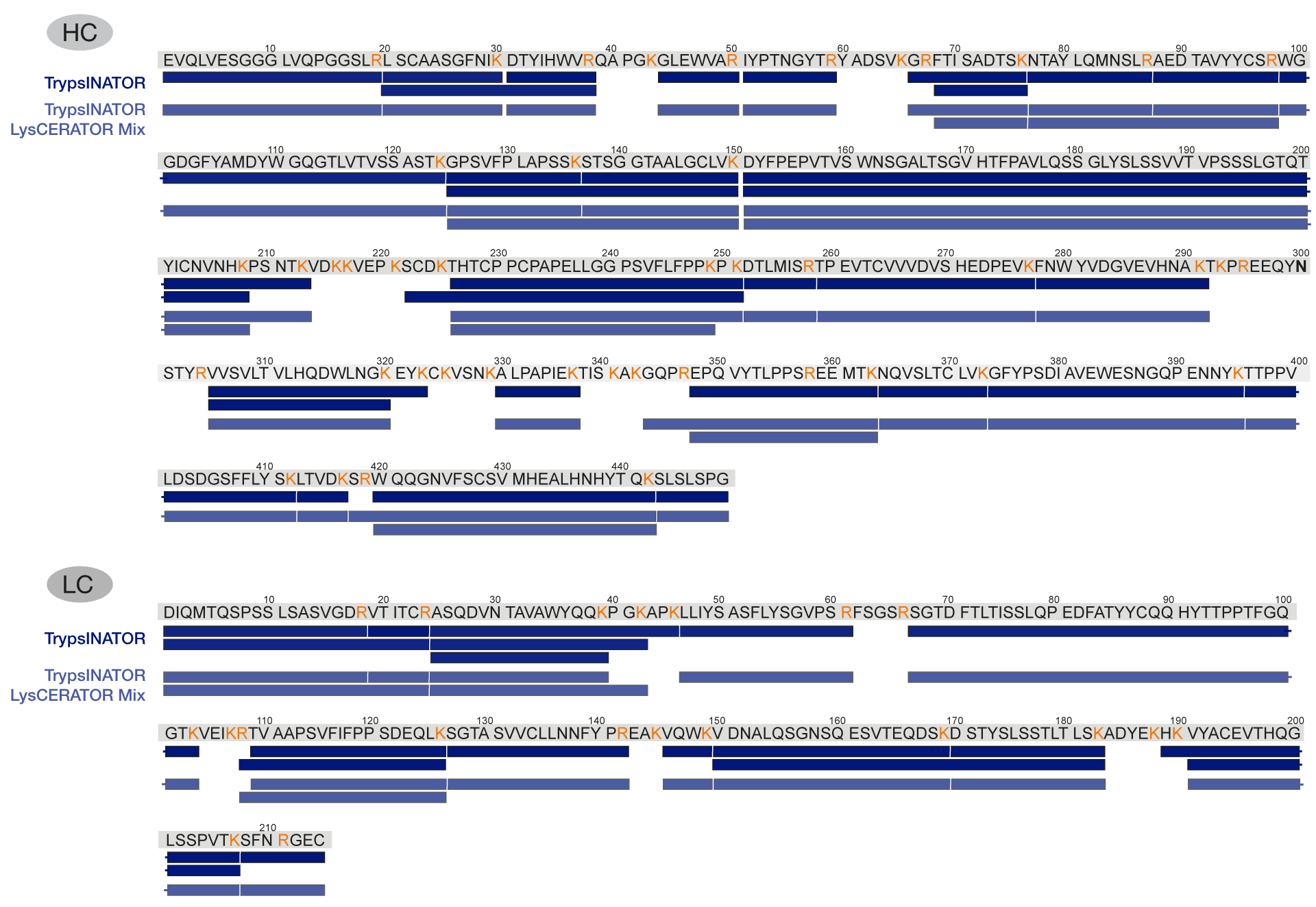
To further demonstrate the use of TrypsINATOR and TrypsINATOR LysCERATOR Mix, the sequence coverage of trastuzumab was determined following digestion with each enzyme product. Following a 2-hour digestion, the sequence coverage using TrypsINATOR was 89.5% and 92.1% for the heavy chain and light chain, respectively. Using TrypsINATOR LysCERATOR Mix, the sequence coverage was 88.6% and 89.7% for the heavy chain and light chain, respectively (Fig. 2). The slightly lower sequence coverage for TrypsINATOR LysCERATOR Mix is due to more efficient cleavage, following the addition of LysCERATOR, at sites where lysine residues are in close proximity and the generated peptides are too short to be efficiently detected by MS. Furthermore, the data show that the digestion efficiency at K-P sites is increased using the TrypsINATOR LysCERATOR Mix, but that the efficiency towards a few of the arginine sites is slightly lower.
High sequence coverage increases confidence in peptide mapping workflows
Related Products
TrypsINATOR™ LysCERATOR Mix Lyophilized
Lyophilized enzyme mix for arginine- and lysine-specific protein digestion

Resources
TrypsINATOR™
Download Product Folder