SmartEnzymes™


Below Hinge Digestion of Mutated IgG

Below Hinge Digestion of Hinge-mutated IgG Formats

FabRICATOR Xtra LALA is an IgG-specific protease that digests antibodies which have been engineered to contain mutated hinges, including the LALA mutation. It digests below the hinge, generating F(ab’)2 and Fc fragments.

Therapeutic antibodies are frequently engineered to significantly reduce or completely eliminate their Fc effector functions while maintaining their ability to bind antigens. This process, known as Fc silencing, is typically achieved by introducing mutations in the antibody's hinge region and is especially important in treatments where immune activation could cause harmful side effects. One of the earliest and most widely used strategies is the LALA mutation (L234A, L235A). However, engineering Fc silencing is not a one-size-fits-all solution, and over the years, numerous other mutation combinations have been developed to optimize the therapeutic profile of antibodies.

Bispecific antibody (bsAb) formats represent a rapidly growing class of biotherapeutic modalities. These antibodies are highly valuable in therapeutic applications due to their ability to bind two distinct targets simultaneously, enhancing both specificity and efficacy in disease treatment. Their unique capacity to engage multiple biological pathways or cells, such as recruiting immune cells to tumors, makes them particularly effective in areas like cancer immunotherapy and autoimmune disease treatment. However, a major challenge in bsAb development is chain mispairing, where incorrect pairing of heavy and light chains can compromise efficacy and lead to the formation of non-functional or off-target antibodies. Careful analysis of bispecific antibody chain pairing variants is, therefore, essential to ensure correct assembly and maintain therapeutic function.

FabRICATOR Xtra Digestion

Subunit Analysis of Hinge-mutated IgG Formats

As most of the mutations in hinge-mutated antibodies, including LALA, occur in the lower hinge region, they can be challenging for IdeS to digest, preventing subsequent subunit analysis. FabRICATOR Xtra LALA digests IgG formats which have been engineered to contain mutated hinge regions below the hinge, generating F(ab’)2 and Fc fragments. These fragments can be reduced to Fd’, LC and scFc for comprehensive subunit analysis of hinge-mutated IgG.

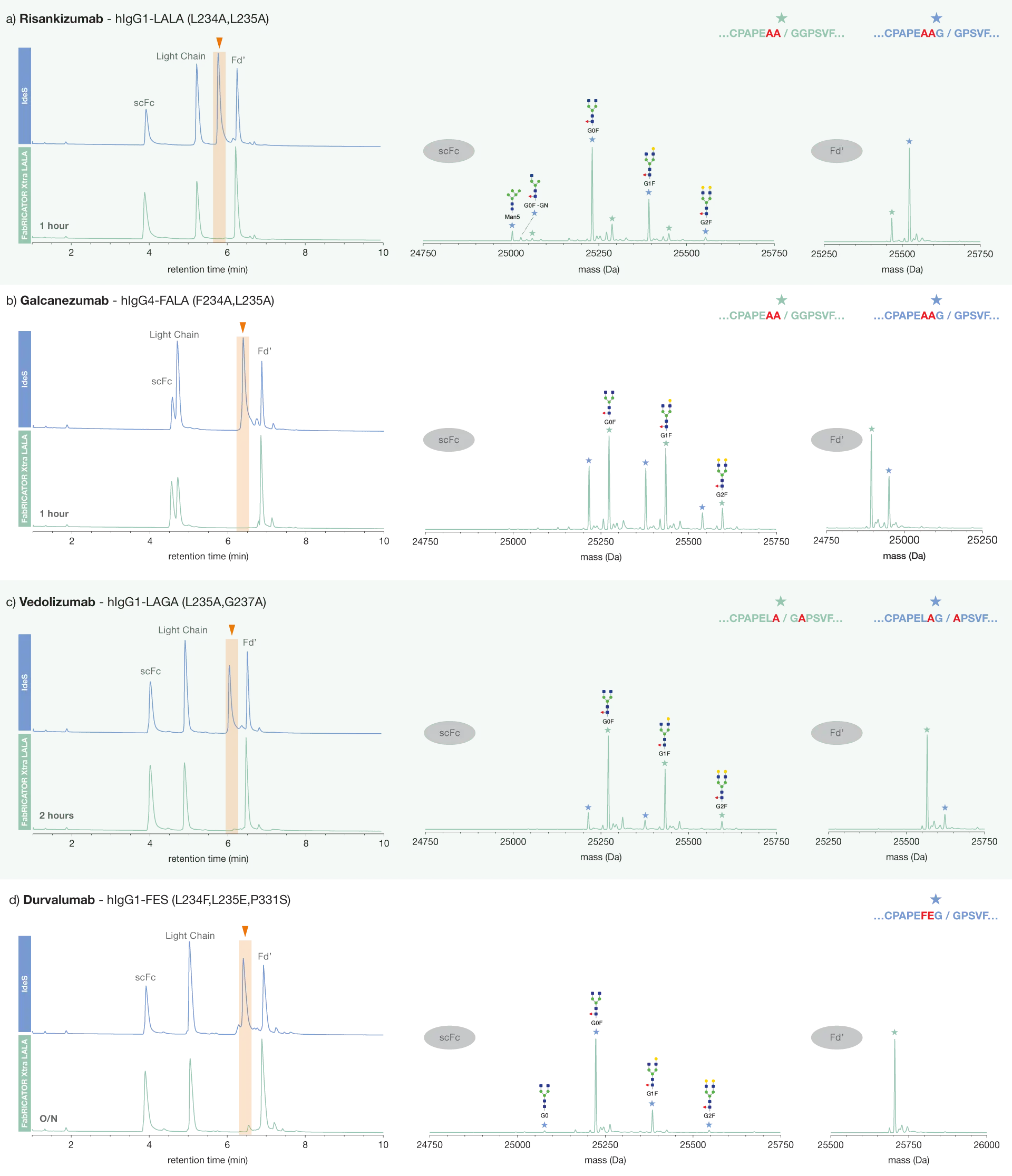
Here, we demonstrate the activity of FabRICATOR Xtra LALA on a variety of engineered antibodies with different combinations of silencing mutations (Fig. 1). We tested a molecule containing the classical LALA mutation, a human IgG4 containing the analogous FALA (F234A, L235A) mutation, as well as a human IgG1-LAGA (L235A, G237A) and a human IgG1-FES, which, in addition to the lower hinge mutations L234F and L235E, also contains an additional mutation in the CH2 (P331S).

FabRICATOR Xtra LALA digests all of these formats more effectively than IdeS, allowing for their characterization by LC-MS at the subunit level. In the majority of cases, two FabRICATOR Xtra LALA digestion sites were detected, with digestion occurring after either residue 235 or residue 236.

Figure 1. FabRICATOR Xtra LALA activity towards different hinge-mutated IgG formats. A variety of different hinge-mutated IgG formats were digested using FabRICATOR Xtra LALA (PBS, 20 mM DTT, 37°C) and the resulting subunits were analyzed by reversed-phase LC-MS analysis on a Waters™ BioAccord™ LC-MS system equipped with a Waters™ BioResolve™ RP mAb column (2.1 x 50 mm). a) Risankizumab (hIgG1-LALA) and b) galcanezumab (hIgG4-FALA) were digested with 1 unit FabRICATOR Xtra LALA per µg IgG for 1 h, c) vedolizumab (hIgG1-LAGA) with 2 units FabRICATOR Xtra LALA per µg IgG for 2 h and d) durvalumab (hIgG1-FES) with 3 units FabRICATOR Xtra LALA per µg IgG overnight (O/N). The antibodies were also digested with IdeS under the same reaction conditions for comparison. Shown are the chromatograms (UV 280 nm, left) as well as the deconvoluted mass spectra of the scFc and Fd’ subunits (middle and right, respectively). In a-c, the different colored stars highlight which peaks correspond to digestion at each of the indicated sites shown in the figure.

FabRICATOR Xtra Digestion

Analysis of Chain Pairing Variants in a Bispecific IgG4

Subunit analysis by LC-MS is a powerful approach to assess chain pairing variants in bispecific antibodies. By digesting the bsAb into scFc and F(ab’)2 fragments, the correct pairing of both the heavy and light chains can be analyzed in a single fragment (the F(ab’)2) without having to account for the complexity and heterogeneity introduced by Fc glycosylation. Many bsAb formats are heavily engineered and often contain Fc silencing mutations. While these modifications ensure correct assembly of the antibody and allow for control over Fc effector functions, they also make subunit analysis using traditional tools, such as IdeS, more challenging.

Here, we demonstrate analysis of a bispecific human IgG4 antibody, talquetamab, which contains the Fc silencing mutations F234A and L235A in the lower hinge. FabRICATOR Xtra LALA efficiently digested this antibody into scFc and F(ab’)2 fragments which were easily separated by reversed-phase chromatography. MS analysis of the F(ab’)2 fragment demonstrates correct assembly of the bsAb and the absence of any chain pairing-related impurities (Fig. 2).

Figure 2. Subunit analysis of a bispecific human IgG4. A bispecific antibody, talquetamab (hIgG4-FALA), was digested using FabRICATOR Xtra LALA (1 unit per µg IgG, PBS, 37°C) for 1 h followed by reversed-phase LC-MS analysis on a Waters™ BioAccord™ LC-MS system equipped with a Waters™ BioResolve™ RP mAb column (2.1 x 50 mm). scFc and F(ab')2 fragments were chromatographically separated (top panel) and the deconvoluted spectrum of the F(ab’)2 subunit (bottom panel) demonstrates correct assembly of the bsAb with regards to both the heavy and the light chains. The orange arrows indicate the masses where light chain pairing variants would be detected, further demonstrating their absence. The asterisks correspond to species where either one, or both, of the antibody heavy chains have been digested after residue 236.

Contact Us