SEQURNA® Thermostable RNase Inhibitor
Synthetic thermostable RNase inhibitor ideal for single-cell and in situ RNA sequencing

Application
Inhibition by synthetic RNase inhibitor (SEQURNA) matches or surpasses recombinant inhibitors in Smart‑seq2 and Smart-seq3 library preparation, including RNase‑rich tissues.

Single‑cell RNA‑seq protocols such as Smart‑seq2 and Smart‑seq3 impose additional stress on RNA through heat steps and low input, and tissues like spleen and liver present elevated endogenous RNase activity. To assess whether SEQURNA can sustain data quality under these demanding conditions, its performance was evaluated in single HEK293FT cells and small cells from RNase‑rich mouse tissues across Smart‑seq2, Smart‑seq3 and Smart‑seq3xpress.
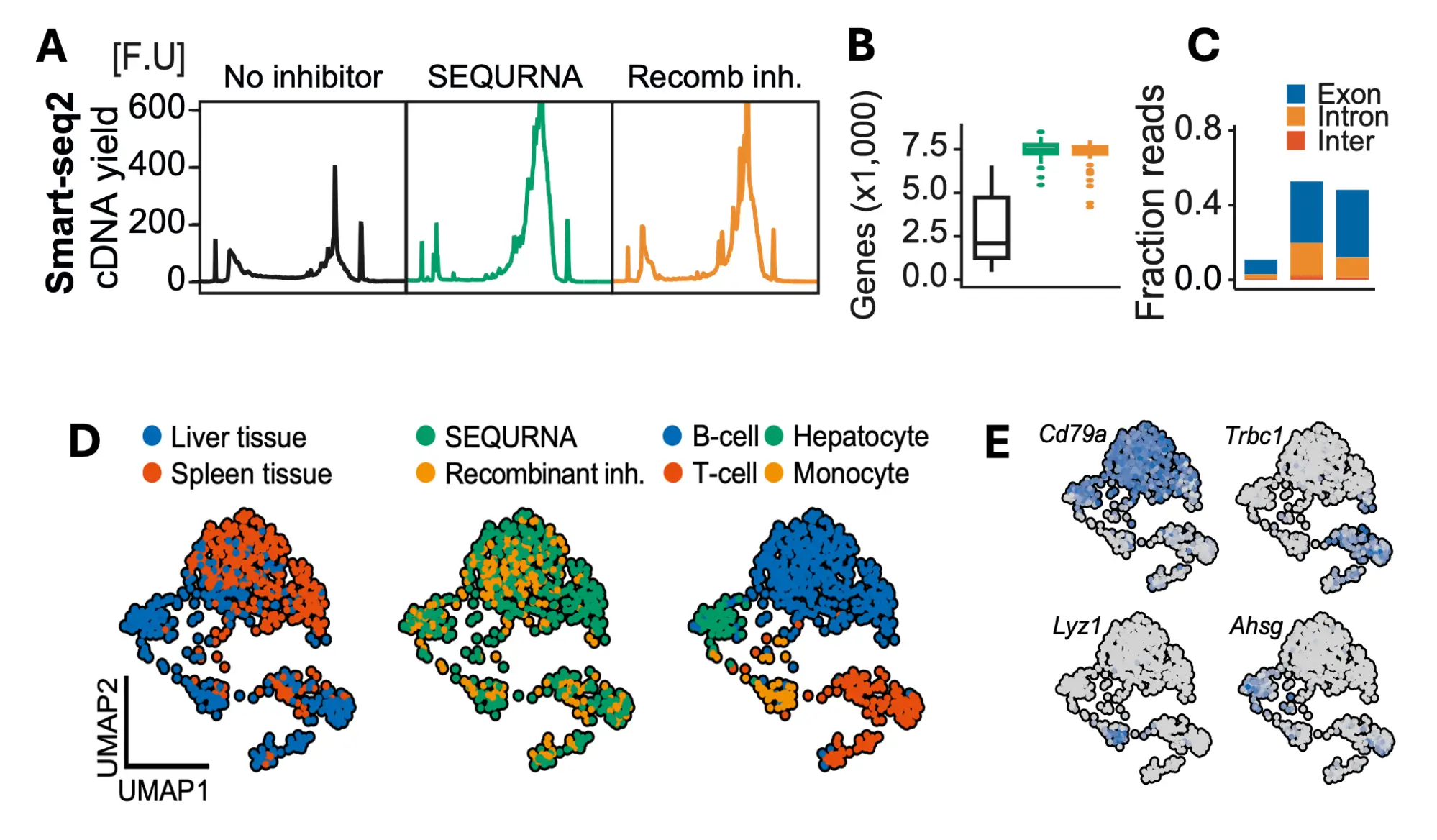
In Smart‑seq2, individual HEK293FT cells were FACS‑sorted into lysis buffer containing a SEQURNA titration (0–24 U/µl) or standard buffer with recombinant RNase inhibitor, followed by the usual 72°C denaturation and reverse transcription. At SEQURNA concentrations around 2–3 U/µl, single‑cell libraries produced cDNA yields, mapping rates, gene detection (Fig. 2a-c) and biological read‑outs, such as cell‑cycle signatures (not shown), that were comparable to the recombinant inhibitor condition, demonstrating effective protection of minute transcript pools throughout the workflow.
Single HEK293FT cells and small spleen/liver cells yield Smart‑seq2 libraries comparable to recombinant inhibitors.
To challenge SEQURNA in RNase‑rich environments, small cells from mouse spleen and liver were sorted into lysis buffers containing either SEQURNA (3 or 4.5 U/µl) or recombinant inhibitor and processed with Smart‑seq2. Library quality metrics remained highly similar across inhibitor types (not shown). Dimensionality reduction placed SEQURNA‑ and RRI‑treated cells throughout clusters corresponding to B cells, T cells, monocytes/macrophages and hepatocytes, indicating successful transcriptome capture regardless of inhibitor (Fig. 2d, e).
In conventional Smart‑seq2, RRIs are added twice — before lysis and again before reverse transcription after 72°C denaturation — whereas SEQURNA is added once in the lysis buffer and remains effective throughout.
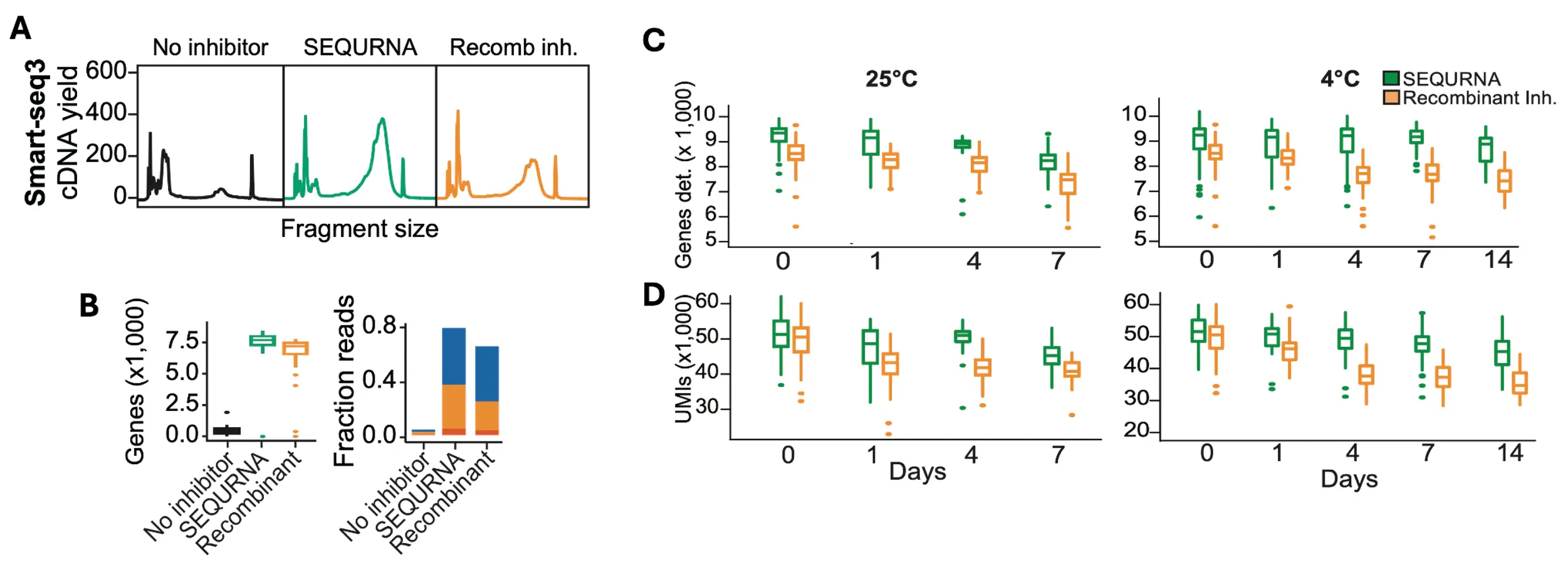
In Smart‑seq3, SEQURNA was tested on purified mouse RNA and single HEK293FT cells at 0.06–0.6 U/µl in lysis (0.03–0.3 U/µl in RT). Within this range, SEQURNA maximized cDNA yield and produced sequencing data with quality metrics (Fig 3a, b) and UMI counts (not shown) that matched or surpassed those generated with recombinant inhibitors, confirming compatibility with 3′‑tagging and UMI‑based quantification. The Smart‑seq3xpress protocol further demonstrated that SEQURNA maintains library quality even under reduced reaction volumes and was used to systematically assess the impact of extended storage (up to 14 days) of lysed single cells on data quality. SEQURNA preserved workable cDNA profiles after 14 days at 4°C and 4 days at room temperature (25°C), compared to no-inhibitor controls that showed clear degradation (Fig. 3c, d).
Additional stress‑tests where SEQURNA stocks were exposed to elevated temperatures, repeated freeze–thaw cycles, prolonged vortexing and wide pH variation all yielded intact Smart‑seq2 cDNA traces, depicting the robustness of the synthetic inhibitor in scenarios that challenge protein‑based reagents.
Together, these data demonstrate that SEQURNA sustains high‑quality single‑cell Smart‑seq2 and Smart‑seq3 libraries across cell types, including RNase‑rich tissues, while tolerating high‑temperature steps that would compromise conventional recombinant inhibitors.
Smart‑seq3 and Smart‑seq3xpress libraries show equal or superior quality metrics with SEQURNA.
Synthetic thermostable RNase inhibitor ideal for single-cell and in situ RNA sequencing
Download Product Folder

Download Detailed Protocol

Download Detailed Protocol

Download Published Article
