Native Antigen Recovery from Immune Complexes using AlligBAITOR™ Lyophilized
Application
Simple and rapid workflow for native antigen release from Fc-affinity captured antibody complexes for downstream characterization and validation.

Isolating antigens from antibody-bound immune complexes for characterization typically involves harsh chemical methods which subsequently damage the antigens, potentially having a detrimental impact on their analysis. For more meaningful downstream analysis of antibody-bound antigens, disrupting immune complexes under physiological conditions would be desired. AlligBAITOR enables native antigen release from immune complexes, preserving their structural and functional properties while crucially, integrating seamlessly with standard purification workflows. This results in a practical pathway for obtaining biologically relevant samples suitable for downstream analyses that can drive therapeutic development decisions.
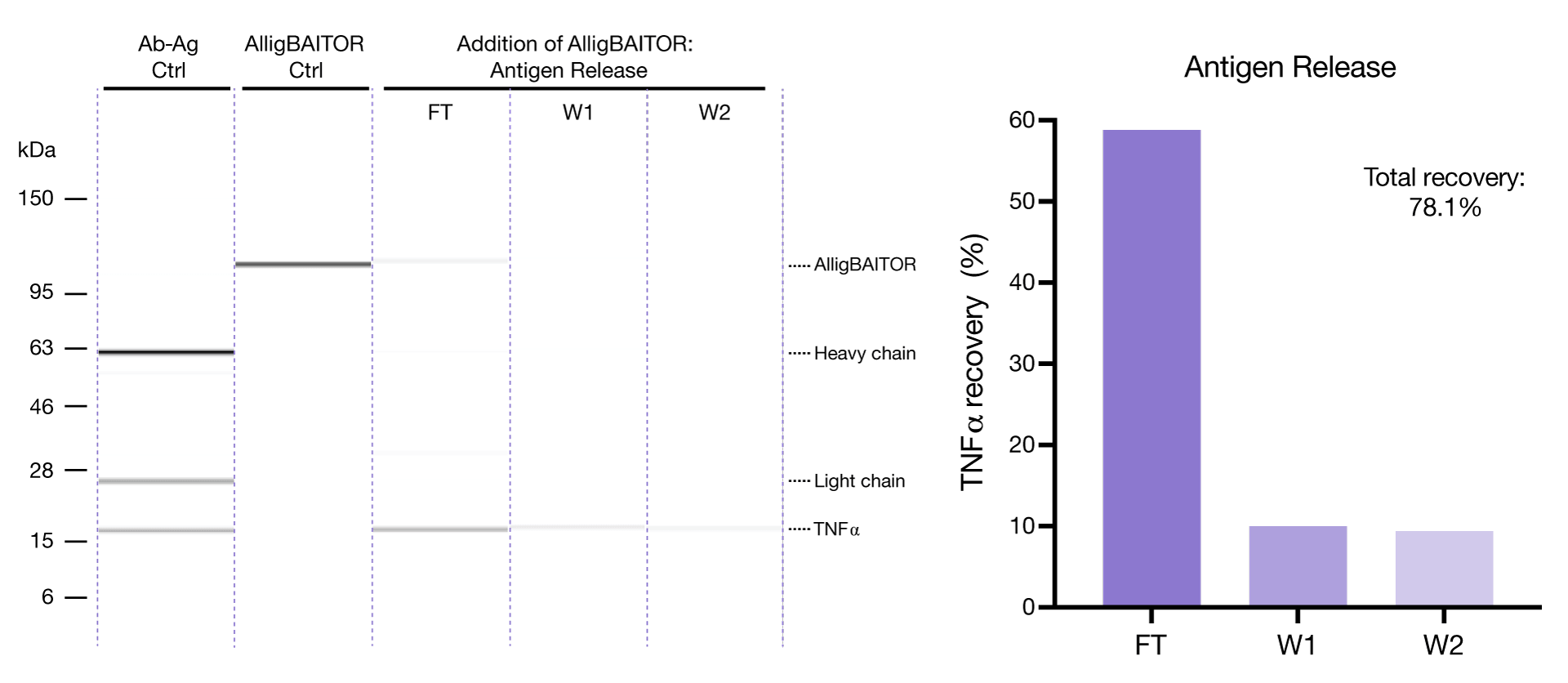
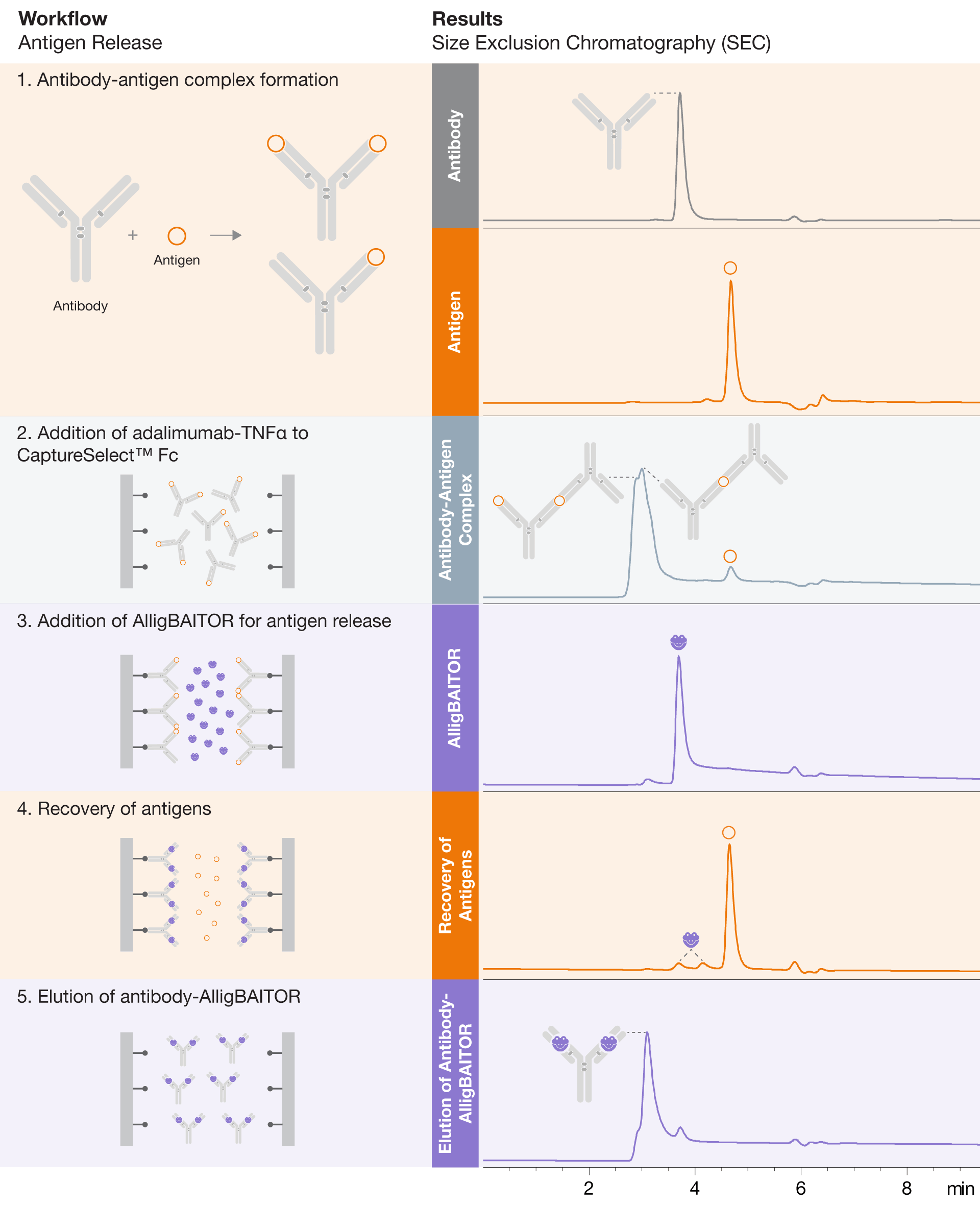
AlligBAITOR enables selective release of antigens from antibody-antigen complexes via high-affinity binding at the immunoglobulin Fab domain. Disrupting immune complexes in this way supports a highly efficient approach to isolate bound antigens from complex samples under native conditions. Antigen-bound antibodies are captured on CaptureSelect™ Fc resin, followed by the addition of AlligBAITOR Lyophilized, which binds to the immunoglobulin Fab region and releases the bound antigens. The antigens are subsequently eluted under conditions that preserve their native structure. Here, we describe the workflow and demonstrate the release and recovery of purified TNFα using AlligBAITOR to disrupt its interaction with adalimumab following capture of the immune complex using CaptureSelect Fc (Fig. 1a). This is demonstrated through Size Exclusion Chromatography (SEC) (Fig. 1b) and Capillary Electrophoresis-Sodium Dodecyl Sulfate (CE-SDS) (Fig. 2).
Native release and recovery of purified antigens
AlligBAITOR enables efficient antigen recovery through a streamlined workflow requiring only a few simple handling steps and can be completed in less than two hours. The method delivers reproducible performance across experiments, supporting consistent antigen recovery and reliable results. Its straightforward implementation and compatibility with standard laboratory procedures make AlligBAITOR well suited for both routine sample processing and high-throughput workflows.
Simple, rapid, and robust workflow
The workflow presented here was developed using a CaptureSelect Fc resin; however, AlligBAITOR is compatible with a wide range of Fc-binding affinity resins. Since AlligBAITOR binds the CH1 domain of antibodies, Fc-mediated capture remains available throughout the workflow, enabling the use of commonly employed reagents, such as Protein A and Protein G. If capture of other human immunoglobulin isotypes or other species immunoglobulin is desired, CaptureSelect affinity resins have several different binding characteristics (IgA-XL, IgE, POROS IgM-XL, etc.). Fab-binding resins are not recommended, as binding near the AlligBAITOR interaction site may introduce steric hindrance and reduce efficient disruption of antibody-antigen complexes.
Broad compatibility with a range of Fc-affinity capture platforms.