
Characterization of Bispecific Antibody Chain Pairing using FabDELLO®
Application
Improved characterization of bispecific antibody chain mispairing by FabDELLO subunit digestion and LC-MS resolution of Fab variants.
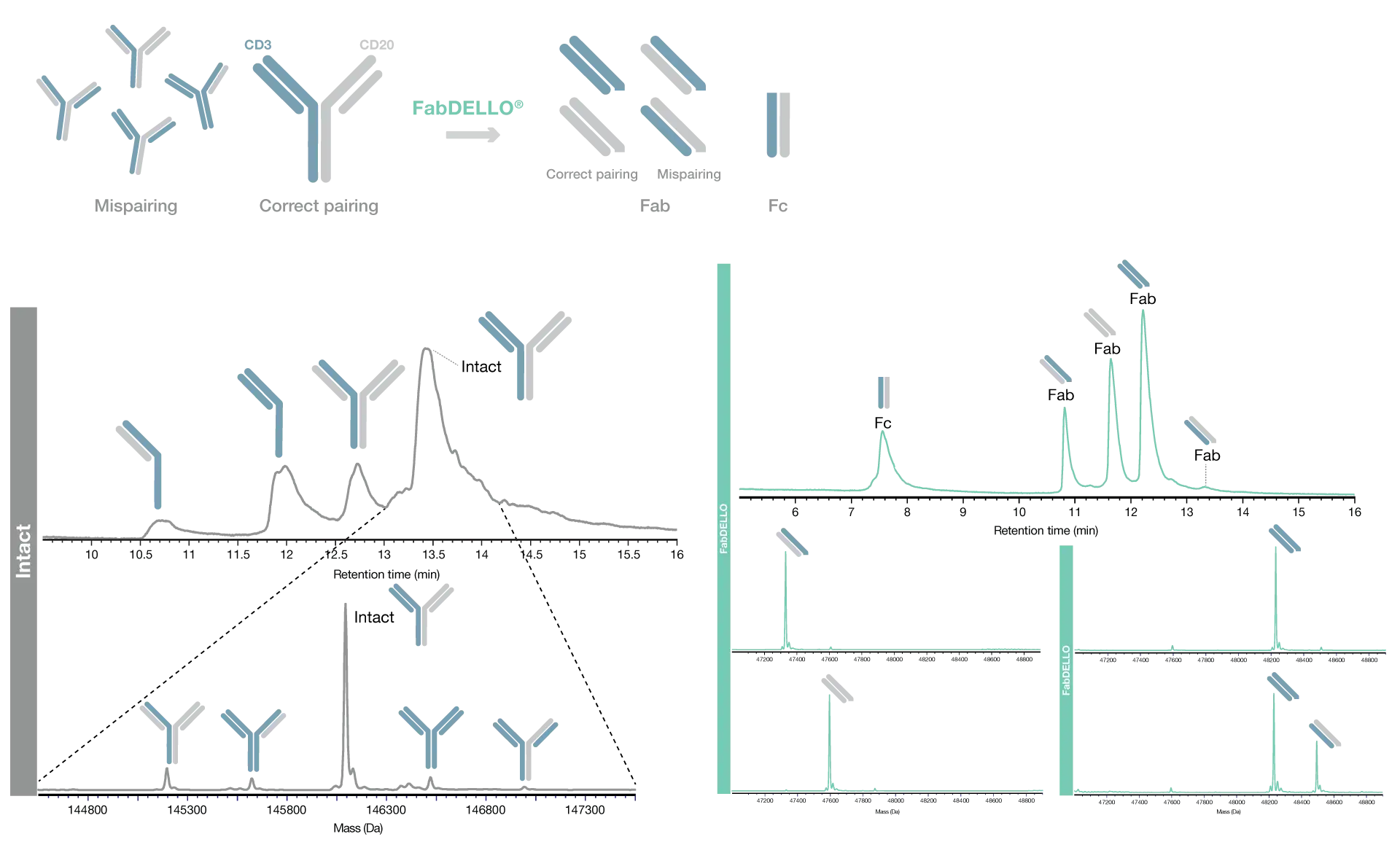
Production of bispecific antibodies by co-expression of the different heavy and light chain components is an efficient system to produce the desired molecular structure. However, in addition to the correctly paired molecule, mispaired variants can be formed due to mis-association of the different chain components. This is represented at the top of the slide, and these product-related impurities need to be characterized and monitored throughout process development.
Here, we analyzed a purified research grade recombinant bispecific human IgG1 antibody with anti-CD20-anti-CD3 specificity, by LC-MS both at the intact level, and at the subunit level following FabDELLO digestion. At the intact level, we can identify a number of species alongside the major peak. These species, however, are not chromatically well resolved, to the extent that several minor species can be observed along with the correctly assembled species. Co-elution such as this can make characterization and quantification of the relative mispaired variants difficult. In addition, if there is a small mass difference between the correctly assembled and mispaired species, these variants may not be able to be unambiguously distinguished at this level making full characterization very difficult.
Co-elution of correctly assembled and mispaired bispecific species at the intact level
Digesting the bispecific antibody with FabDELLO, intact Fab fragments are generated which allows for more confident analysis of chain mispairing. Since the different chain mispaired variants are chromatographically resolved to a greater extent, and yield unique Fab masses at the subunit level, there is no risk for mis-annotation. Here, we observe that in addition to the expected Fd + LC Fab combinations, some mispaired variants are revealed. These species can be more confidently identified after FabDELLO digestion that at the intact level FabDELLO digestion offers better chromatographic resolution, higher sensitivity of the different variants, increased confidence and much simpler quantification of the chain mispairings.
Improved resolution of chain mispaired variants at the subunit level
A further advantage of the middle-level approach is that it allows for supplementary PTM characterization. Separating the antibody into the smaller Fc and Fab fragments, or when reduced using DTT into the even smaller Fc/2, LC and Fd fragments, improves the separation and resolution of these species. This enables identification of additional modifications, and subunit-specific localization. At the intact level, it is much more difficult to unambiguously determine the presence of some modifications, and not possible to assign any modifications to a particular part of the molecule.
Middle-level analysis enables supplementary PTM characterization
Related Products

Resources
FabDELLO®
Download Product Folder

FabDELLO® for the Analysis of Bispecific Chain Pairing
Download Scientific Poster

FabDELLO® for the Analysis of Hinge Mutated and Bispecific Antibodies
Download Scientific Poster


