
Mode-of-Action Study of Deglycosylated Antibodies using GlycINATOR™
Application
Removal of Fc N-glycans abolishes ADCC activity, enabling direct study of glycan-mediated Fc receptor interactions and antibody function.

The relationship between antibody core fucosylation and Antibody Dependent Cellular Cytotoxicity (ADCC) is well-established due to its impact on the binding to Fc-receptors. Reduced core fucosylation typically enhances FcγRIIIa binding and increasing ADCC activity, while higher fucosylation generally lowers effector potency.
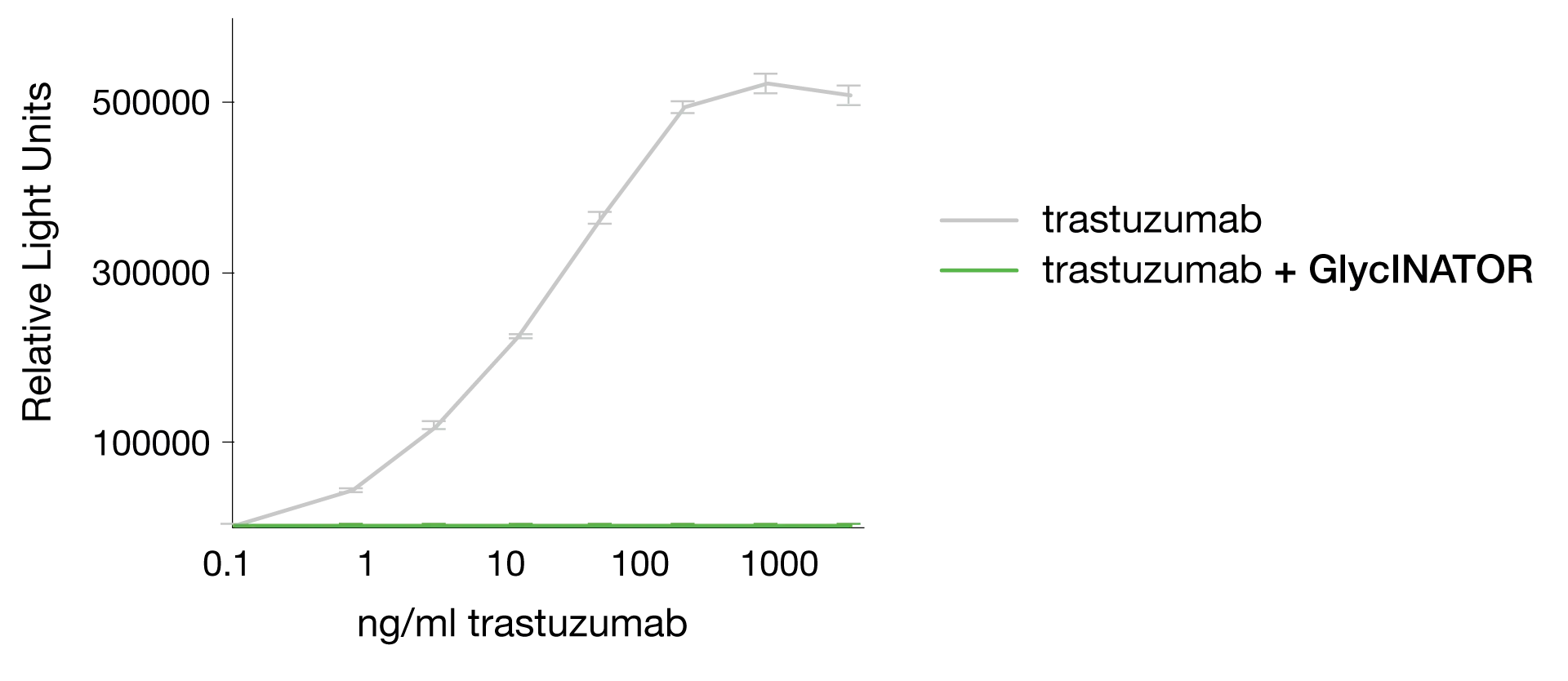
Here, the ability of native and deglycosylated trastuzumab to elicit ADCC was analyzed using the cell based iLite® ADCC assay. In this assay, the native trastuzumab showed an expected antibody-concentration dependent increase in response in the ADCC assay while the trastuzumab which has been digested using GlycINATOR elicited no ADCC, even when the antibody concentration was increased.
Removal of native Fc-N-glycosylation abolishes ADCC
This complete abolition of ADCC following removal of the native Fc N-glycan structure indicates a non-functional interaction between the deglycosylated antibody and the FcgRIIIa. This highlights how GlycINATOR can be used in functional and mode-of-action studies, especially as a tool for removing glycan-mediated interactions.
Non-functional interaction between the deglycosylated antibody and Fc𝛾RIIIa
Related Products

Resources
GlycINATOR™
Download Product Folder

AppNote SmartEnzymes™ for mAb Oxidation
Download Application Notes

