
Degalactosylation to Identify Antibody Glycation using GalactEXO®
Application
Removal of glycan β-galactose to simplify IgG glycan heterogeneity, improve LC-MS analysis, and reveal underlying glycation modifications.

IgG N-glycans drive the interactions with Fc receptors and are, for this reason, of critical importance during the development of therapeutic antibodies. GalactEXO can be used to generate degalactosylated antibodies. By removing the terminal galactose using GalactEXO, much of the glycan heterogeneity is removed and the predominant remaining glycoform is G0F, with minor traces of G0 and Man5 glycans. This simplifies mass spectrometry characterization of the protein and, by removing glycan-associated galactose, it is possible to confidently detect the glycation post-translational modification.
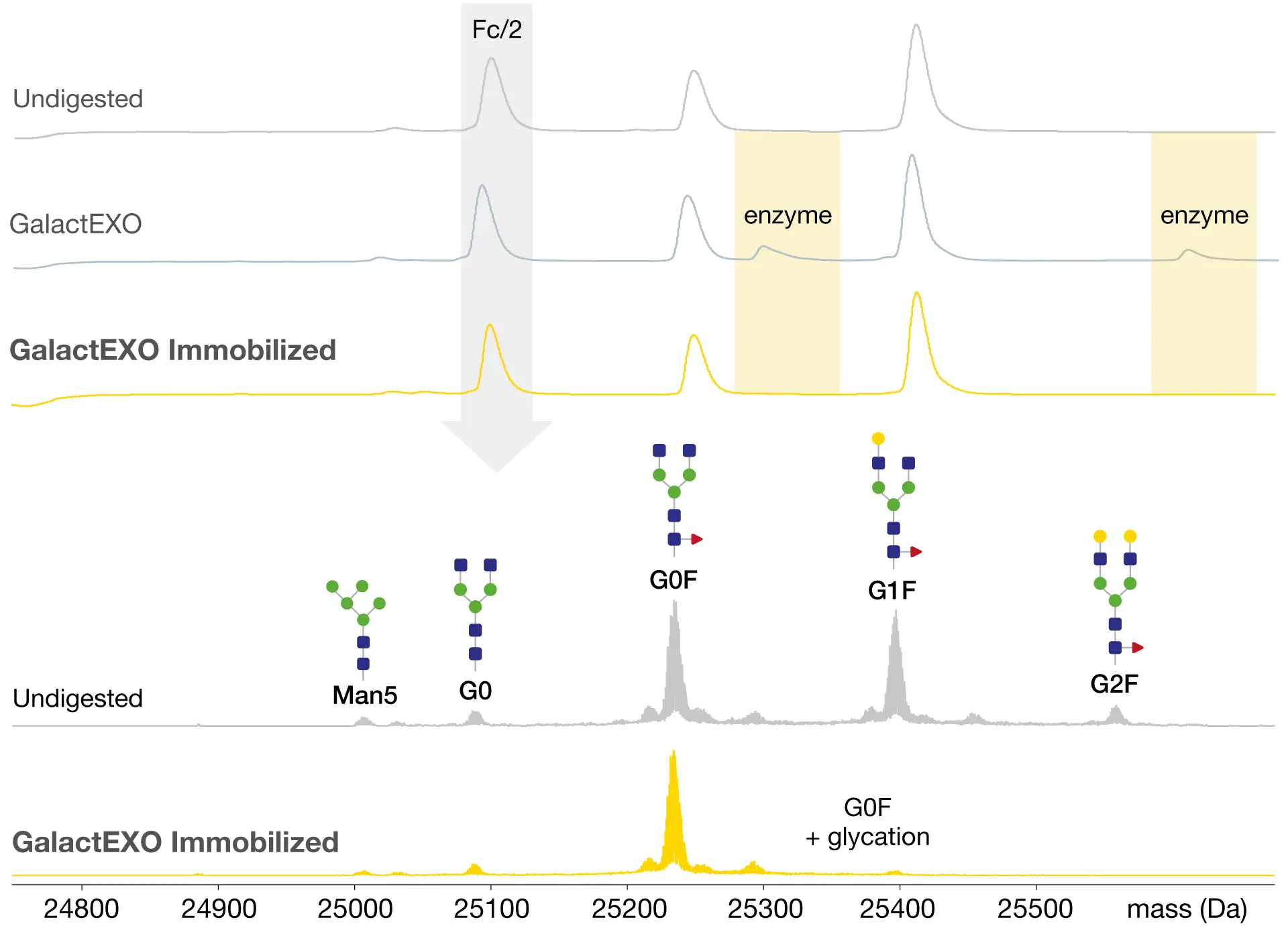
Here, we incubated samples of the antibody trastuzumab with GalactEXO Lyophilized and GalactEXO Immobilized for 30 minutes, before digesting them with FabRICATOR and analysing the subunits by LC-MS. In analysing the scFc subunit, we can observe the complete degalactosylation of the galactose-containing glycoforms, highlighting the high efficiency of the GalactEXO enzyme. The remaining detectable glycoforms are those not conaining any b-galactose; G0F, G0 and Man5. Efficient enzymatic performance is critical to have full confidence in the generated data.
Complete removal of β-galactose from native antibody
Removal of glycan-derived heterogeneity from complex glycoproteins allows clearer characterization of underlying protein modifications. This is particularly important when the modifications are low level and may be masked by the presence of certain glycans.
Here, once we remove the β-galactose from the N-linked glycans, we can observe a glycation modification present on the trastuzumab scFc domain. Glycation is the non-specific addition of a hexose sugar, predominantly to lysine residues, and is generally a result of media components in the upstream development process. Glycation modifications can impact protein structure, function and safety and it is, therefore, very important to be able to identify these. The mass of a hexose sugar is +162 Da, which is the same mass shift as is observed when adding galactose to glycans (for example, the difference between G0F and G1F glycan is +162 Da). This means that the presence of galactosylated glycans mask the presence of protein glycation, and by removing the β-galactose on the glycans, it is possible to confidently observe and characterize the glycation modification.
Removing glycan heterogeneity allows glycation modification to be identified
When using the GalactEXO Lyophilized format, we can observe peaks which correspond to GalactEXO in the UV chromatogram. These enzyme peaks do not interfere with the product peaks, in this instance, however, interfering peaks such as these might not be desirable. Using GalactEXO Immobilized, these interfering peaks are not present as the enzyme remains on the microspin column following digestion. This removes the potential for issues caused by interfering enzyme in further analytical applications which is of particular importance when structural or functional characterization methods are going to be performed.
Immobilized format eliminates enzyme from the final sample
Related Products

Resources
GalactEXO®
Download Product Folder

SmartEnzymes™ for the Glycosylation Charcterization of Glycoproteins
Download Scientific Poster


