
OpeRATOR™ for O-glycan site mapping
Application
Precise O-glycan site mapping by generating small, MS-friendly O-glycopeptides and improved confidence through overlapping sequence coverage.


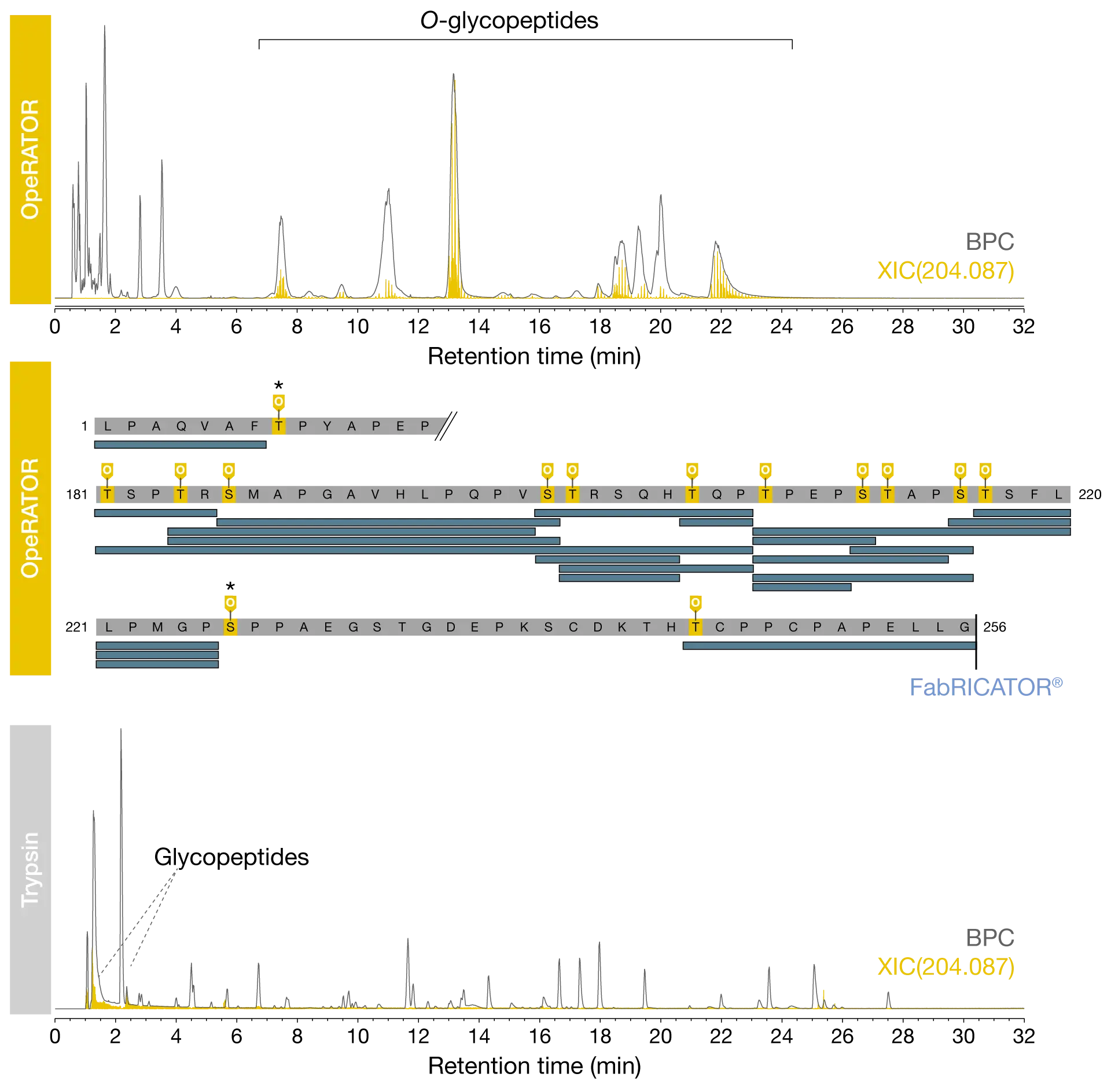
OpeRATOR offers a solution with several advantages over traditional peptide mapping workflows for comprehensive O-glycan site mapping. The etanercept hinge region is highly O-glycosylated and, typically, within these patches of O-glycosylation there are several serine, threonine and proline residues, but not so many lysine or arginine residues. This makes unambiguous glycan site mapping difficult, even when using MS fragmentation techniques such as ETD.
Comprehensive O-glycan site mapping
Use of traditional proteases such as trypsin, often generates very large peptides containing multiple O-glycans and in the case of etanercept, there can be up to seven glycans on a single tryptic peptide. Because OpeRATOR digests at each site of O-glycosylation, when analysing a protein such as etanercept, the high number of O-glycan sites present in close proximity means that the generated peptides are generally small, contain only 1-2 O-glycans per peptide, and are much easier to analyze.
OpeRATOR generates small peptides with typically 1-2 O-glycans per peptide
While OpeRATOR cleaves at each glycan site, some mis-cleavage is also observed. This leads to some peptides containing more than one O-glycan, and also leads to the generation of overlapping peptides. This is useful for glycan site mapping as, while smaller peptides are advantageous for analysis, if they are too small, they would potentially be difficult to identify and possibly impossible to map onto the overall protein sequence, especially within regions which might containing repeating sequences. Overlapping peptides aid unambiguous glycan site identification as there are multiple generated peptides which contain the glycan site which improves the overall confidence in their characterization.
Overlapping peptides increase confidence in glycan site identification
Related Products

Resources
OpeRATOR™
Download Product Folder

AppNote OpeRATOR™ for Determination of O-glycan Sites
Download Application Notes
How OpeRATOR™ Works
Watch video
SmartEnzymes™ for O-glycosylation Analysis using Mass Spectrometry
Download Scientific Poster

SmartEnzymes™ for O-glycosylation Analysis using LC-MS
Download Scientific Poster


