
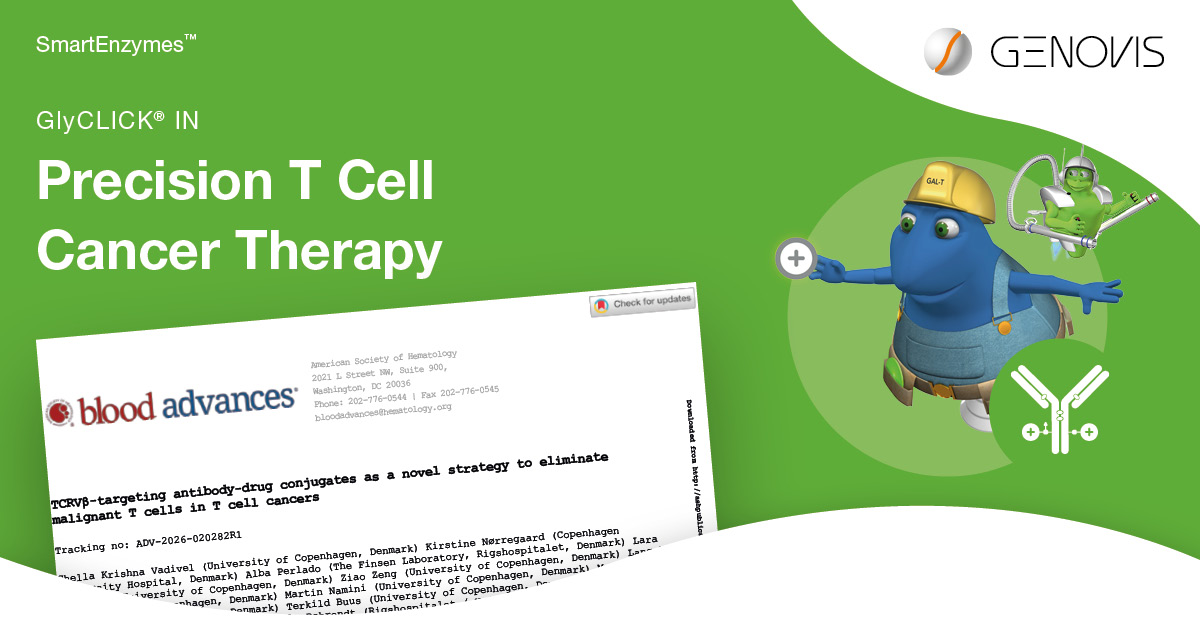
TCRVβ2-Targeted ADCs Show Promise for Precision T Cell Cancer Therapy
A recent study published in Blood Advances demonstrates how site-specific antibody-drug conjugates (ADCs) targeting TCRVβ2 can selectively eliminate malignant T cells while sparing most healthy T cells. Using our GlyCLICK® technology, the researchers generated homogeneous anti-TCRVβ2 ADCs with defined drug-to-antibody ratios and potent anti-tumor activity both in vitro and in vivo.
Patients with advanced cutaneous T-cell lymphoma (CTCL) have a poor prognosis, largely due to treatment failure and infection. Cancer T cells exhibit heterogeneous expression of actionable surface targets across subclones, complicating therapy and promoting resistance to chemotherapies and biologics. In contrast, all malignant subclones in any given patient share an identical, clonally rearranged T-cell receptor (TCR), which serves both as a diagnostic hallmark and a unique therapeutic target. While TCR constant region-directed therapies have shown potential, they may also deplete up to half of the normal T-cell repertoire.
To overcome this challenge, Vadivel et al. instead targeted the TCR variable beta-chain family TCRVβ2, which is expressed only on a small subset of healthy T cells but expressed across malignant cells in individual patients. By analyzing publicly available single-cell RNA and TCR sequencing data from 104 CTCL patients, the authors identified TCRVβ2 (TRBV20-1) as the most expressed TCRVβ subtype in malignant T cells.
To generate the ADCs, the researchers used our GlyCLICK technology for glycan-directed conjugation in combination with a click-reactive DBCO-PNU. This strategy enabled precise Fc-directed conjugation while preserving antibody binding and function. The generated ADCs have a homogenous conjugation and a defined DAR = 2.0.

The anti-TCRVβ2-PNU ADC selectively induced cell death in primary malignant T cells from TCRVβ2-positive CTCL patients, whereas the unconjugated antibody showed minimal cytotoxicity, highlighting the importance of ADC-mediated payload delivery. No significant killing was observed in TCRVβ2-negative patient samples or healthy donor cells lacking TCRVβ2 expression, demonstrating strong target specificity.
This study highlights the value of site-specific conjugation technologies for next-generation ADC development. By enabling controlled Fc-directed payload attachment, GlyCLICK supports the generation of homogeneous ADCs with defined DAR and preserved antibody functionality — key properties for developing safer and more effective targeted therapeutics. The work further demonstrates the versatility of GlyCLICK in emerging therapeutic areas including hematologic malignancies and precision immunotherapies.
Link to Product
Learn more about GlyCLICK