
Mapping the O-glycoproteome Using Site-Specific Extraction of O-linked Glycopeptides
The Tn-antigen is characterized by the presence of a single N-Acetylgalactosamine (GalNAc) residue linked to serine or threonine residues on proteins. It is an immature glycoform without extension to form any of the common O-glycan core structures. The Tn antigen is a hallmark of many forms of cancer and rarely found in healthy tissue. Mapping and comparing Tn-antigens on proteins is therefore of great interest but current methods are laborious and inefficient.
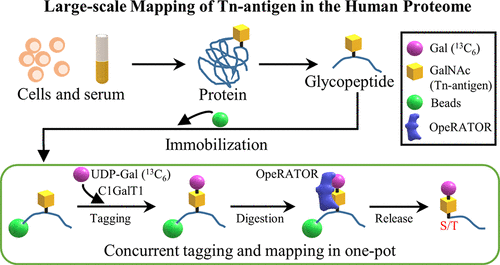
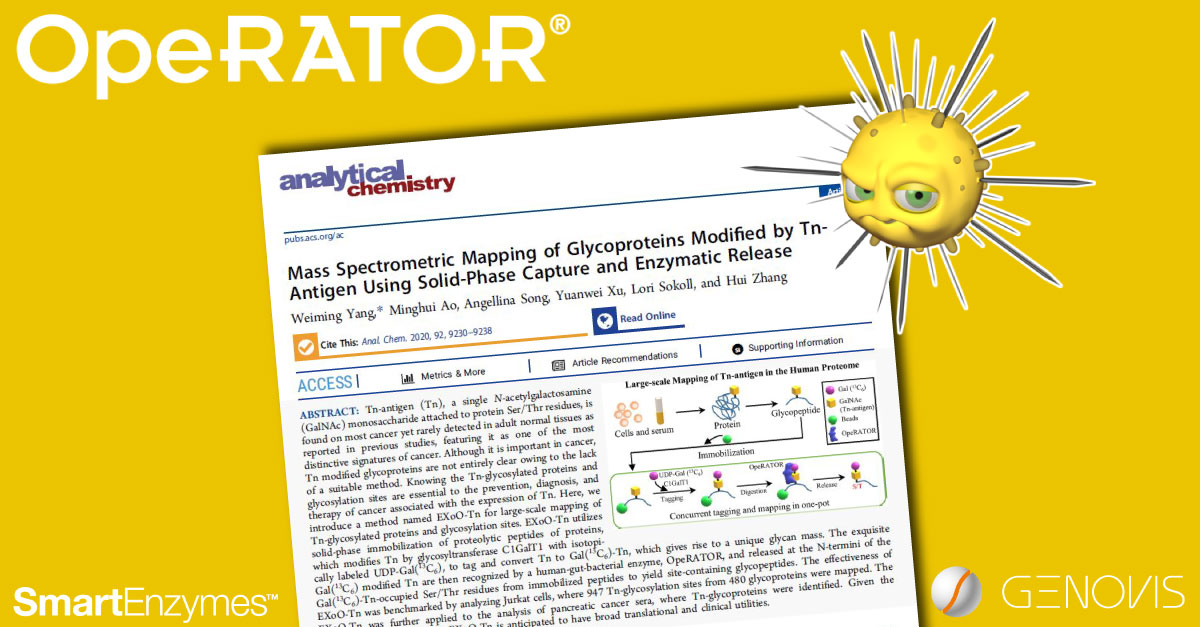
Scientists at Johns Hopkins School of Medicine have developed an ingenious new approach for mapping Tn-antigens from a number of complex samples (Yang et al 2020a). It is based on a technique called ExoO (Yang et al 2018) where tryptic peptides are covalently immobilized on a solid support and digested with OpeRATOR®. As this enzyme can only digest when an O-glycan is present, this results in the specific release of O-glycopeptides which can be analyzed in-depth using LC-MS.
However, OpeRATOR does not digest at sites modified with Tn antigens. To circumvent this limitation, Yang et al. first treated their samples with recombinant C1GalT1, an enzyme able to elongate the Tn antigen into a core 1 structure (Gal-β1,3- GalNAc). Sites modified with core 1 O-glycans are efficiently digested by OpeRATOR and can therefore be mapped in depth using EXoO and LC-MS. To distinguish the Tn-antigen sites from naturally occurring core 1 glycosylation sites, the C1GalT1 reaction was performed in the presence of a heavy isotope labelled donor substrate (13C-UDP-Gal). This introduces a unique mass signature that specifically marks the Tn-antigen sites and is easily detectable by mass spectrometry. Using this new approach, termed EXoO-Tn, Yang et al. were able to identify an approximately 10-fold higher number of Tn-glycosylation sites compared to previous studies.

Link to paper, Yang, W. et al., 2018. Mapping the O-glycoproteome using site-specific extraction of O-linked glycopeptides (EXoO). Molecular systems biology, 14(11), p.e8486.
For a detailed description on how to use OpeRATOR for in-depth mapping of O-glycosylation sites using the EXoO workflow, check also this recent publication in Nature Protocols (Yang et al 2020b)