
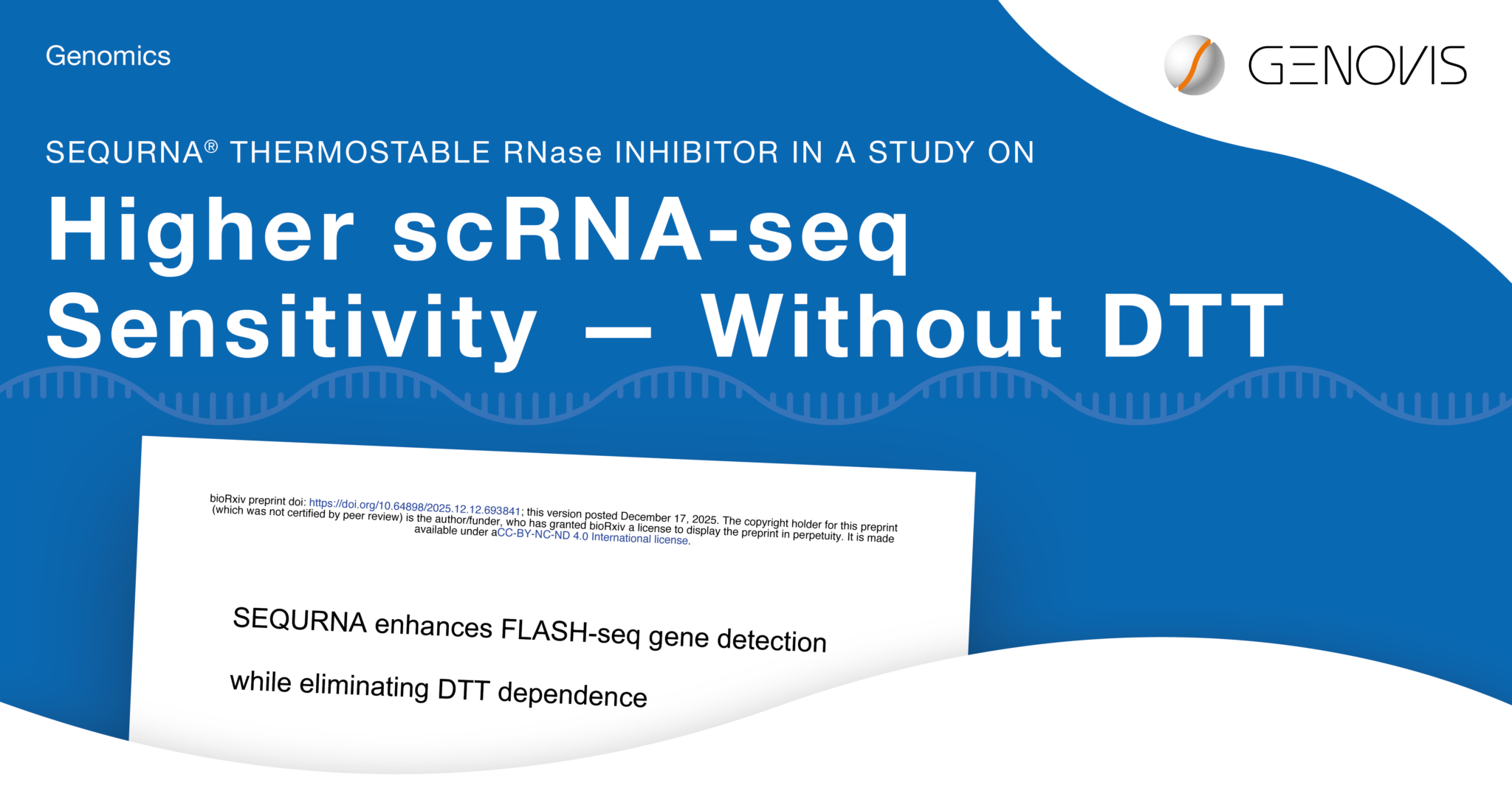
Benchmarking Study Establishes SEQURNA® as a Superior, DTT-Free, RNase Inhibitor for High-Sensitivity Single-cell RNA-seq
A new preprint from the creators of FLASH-seq demonstrates that replacing protein-based RNase inhibitors with the synthetic, thermostable SEQURNA significantly improves sensitivity, especially in low-RNA cells, while enabling a fully DTT-free workflow.
RNA Integrity: A Decisive Factor for Single-cell RNA-seq Sensitivity
In single-cell RNA sequencing (scRNA-seq), preserved RNA integrity constitutes a major bottleneck. Losing a fraction of original transcripts in a bulk RNA-seq experiment is generally negligible, but in a single-cell library, this can turn a truly expressed gene into a technical dropout in the sequencing readout.
Since the inception of scRNAseq, the standard defense against RNA degradation has been protein-based Recombinant RNase Inhibitors (RRIs). While generally effective, these inhibitors come with several limitations: they are oxidation-prone, heat sensitive, relatively costly, and critically dependent on reducing agents such as Dithiothreitol (DTT) to maintain activity.
A new benchmarking study from the Simone Picelli Lab at the Single-Cell Genomics Platform, Institute of Molecular and Clinical Ophthalmology Basel (IOB), reports a key methodological advance. Picelli, the scientist behind the widely used full-length scRNA-seq methods Smart-seq2 and FLASH-seq, and his team show that the SEQURNA synthetic, thermostable RNase inhibitor improves scRNA-seq sensitivity. Importantly, it also renders DTT unnecessary, challenging a long-standing dogma in the field.
The preprint, “SEQURNA enhances FLASH-seq gene detection while eliminating DTT dependence” (Khven et al. 2025) provides a systematic, head-to-head analysis of SEQURNA against industry-standard RRIs.
A Shift to Synthetic RNase Inhibitors
To rigorously evaluate RNase inhibition performance, the authors benchmarked the SEQURNA Thermostable RNase Inhibitor against industry-standard RRIs in the FLASH-seq scRNA-seq protocol across two biologically distinct sample types:
- Human retinal organoids (moderate RNase content)
- Peripheral blood mononuclear cells (PBMCs), a more challenging heterogeneous sample type that includes low-RNA cells
With retinal organoids, SEQURNA delivered a 7–16% increase in median gene detection compared to the best-performing RRI, while maintaining excellent mapping and quality metrics. In lower-RNA PBMCs, where RNA loss has greater impact, the advantage was substantially larger, with SEQURNA, achieving approximately 40% higher gene detection per cell compared to industry-standard RRI.
Effective RNase inhibition becomes more important as transcript abundance decreases. By providing stronger, more stable protection, SEQURNA rescues biological signals that would otherwise be lost to technical dropout. The team identified the optimal SEQURNA concentration in FLASH-seq to be 0.75–1 U/µL in the reverse transcription (RT) reaction.
Data Quality Beyond Gene Counts
The improved sensitivity observed with SEQURNA was not accompanied by noise or artifacts.
- Mapping efficiency increased, indicating longer, less degraded RNA fragments
- Splice junction detection remained high
- Biological heterogeneity was preserved, with no distortion of cell-type composition or batch effects
SEQURNA did not change the biological signals of the single cells — it recovered more of them.
Challenging a DTT Dogma
An even more striking finding of the study concerns DTT:
Traditional RRIs are cysteine-rich proteins that require reducing conditions (typically 5–10 mM DTT) to preserve their folded structure and activity. SEQURNA, on the other hand, is a synthetic, non-protein-based RNase inhibitor that does not rely on disulfide bonds, remains active through heat steps even at 72 °C, and works independently of reducing agents.
Since protein-based RNase inhibitors require reducing agents to remain active, DTT is routinely included in scRNA-seq lysis and reverse transcription (RT) buffers. However, high DTT concentrations may impair RT efficiency, creating a narrow “sweet spot” DTT range where RNA integrity is preserved without compromising reverse transcription.
The Picelli Lab tested DTT across multiple concentrations, and a clear pattern emerged:
- SEQURNA completely obsoleted the use of DTT, enabling DTT-free scRNA-seq
- Omitting DTT improved RT, enabling detection of more transcripts per cell
- Adding DTT was not neutral, it became detrimental to library quality, when shifting to the synthetic RNase inhibitor
Therefore, when RNase inhibition no longer depends on RRI protein stability, DTT becomes an unnecessary and, in this context, even harmful component in the reverse transcription reaction.
Practical Impact: Cost, Stability, and Seamless Adoption
Beyond the science, the study highlighted significant practical advantages.
- Cost Efficiency: The authors noted a potential ~70% cost reduction for RNase inhibition (21 CHF vs 70 CHF per 384-well plate) compared to the leading commercial RRI, an important factor for high-throughput core facilities and clinical studies and scRNA-seq kit providers.
- Workflow Stability: The data showed that samples lysed with SEQURNA could be stored frozen at −80 °C for a month without degradation, supporting flexible, batched experimental designs.
Final Takeaway
This study demonstrates a fundamental shift in RNA protection strategy for single-cell transcriptomics, favoring robust chemical RNase inhibition over conventional protein-based RRIs. The transition away from traditional inhibitors and legacy additive DTT enables researchers to achieve:
- Protocol compatibility: SEQURNA functions as a direct drop-in replacement in FLASH-seq, improving assay sensitivity and robustness
- Defined SEQURNA optimal concentration: 0.75–1 U/µL in the FLASH-seq RT reaction
- DTT-free workflow: safer handling, fewer confounding variables, and improved RT
- Cost efficiency: approximately 70% lower RNase inhibition cost compared to industry-leading RRIs
- Storage stability: samples lysed with SEQURNA remained stable long-term at −80°C
The Picelli Lab has updated the FLASH-seq protocol on Protocols.io to reflect these findings.
Interested in Testing SEQURNA® in Your Workflow?
Check out SEQURNA here, or contact us to discuss collaborations and protocol optimization!
Reference
Khven et al., 2025. SEQURNA enhances FLASH-seq gene detection while eliminating DTT dependence. bioRxiv.
SEQURNA RNase Inhibitor Thermostable – Securing RNA for Sequencing