
Arginine Specific Digestion of Insulin using GingisREX™
Performance Activity
Highly specific arginine-specific protease with limited off-target digestion, enabling clean peptide maps and high-confidence LC-MS data analysis.

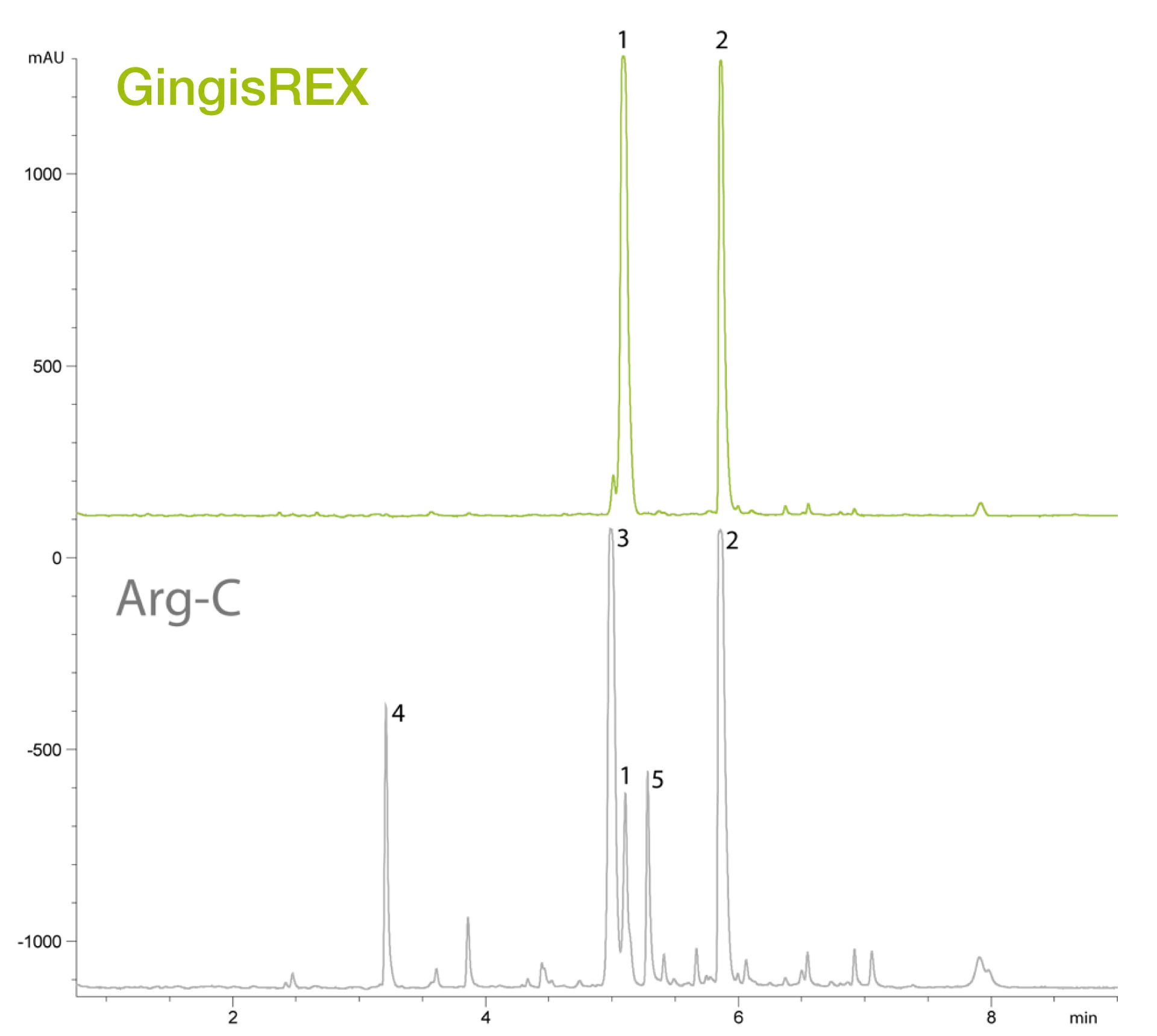
The specificity of proteases for mass spectrometry are crucial to obtain high quality data sets and to avoid complex data interpretation. As a model substrate insulin oxidized β-chain was used to compare the enzymatic specificites of GingisREX and ArgC. Insulin oxidized β-chain contains one arginine and one lysine residue. The digested peptides of both GingisREX and ArgC were analyzed on RP-HPLC and mass spectrometry.
GingisREX exhibited specific digestion at the arginine residue, with no enzymatic activity on the lysine residue or other residues, even after prolonged incubation overnight and with a high enzyme to substrate ratio (1:5). However, ArgC displayed primary activity on arginine residue but enzymatic digestion could also be seen at lysine residues.
Highly specific digestion at arginine residues
Additional non-specific activity of ArgC was demonstrated at an enzyme to substrate ratio of 1:20 and overnight incubation. This was not detected with GingisREX at the same conditions. The data confirmed the specific activity at arginine residues of GingisREX and showed unspecific digestion at lysines and other residues when using Arg-C.
Limited non-specific activity with GingisREX in contrast to Arg-C
Related Products

Resources
GingisREX™
Download Product Folder

GingisREX™ for Characterization of Lysine Conjugated ADCs
Download Scientific Poster

GingisREX™ for Specific Digestion at Arginine Residues
Download Scientific Poster


