FabRICATOR® Xtra LALA Lyophilized 2000 units
Lyophilized enzyme for below hinge digestion of up to 2 mg of hinge-mutated IgG


Application
Efficient analysis of bispecific antibodies, enabling accurate assessment of chain pairing and assembly in Fc-engineered antibody formats

Bispecific antibody (bsAb) formats represent a rapidly growing class of biotherapeutic modalities. These antibodies are highly valuable in therapeutic applications due to their ability to bind two distinct targets simultaneously, enhancing both specificity and efficacy in disease treatment. Their unique capacity to engage multiple biological pathways or cells, such as recruiting immune cells to tumors, makes them particularly effective in areas like cancer immunotherapy and autoimmune disease treatment. However, a major challenge in bsAb development is chain mispairing, where incorrect pairing of heavy and light chains can compromise efficacy and lead to the formation of non-functional or off-target antibodies. Careful analysis of bispecific antibody chain pairing variants is, therefore, essential to ensure correct assembly and maintain therapeutic function.
Subunit analysis by LC-MS is a powerful approach to assess chain pairing variants in bispecific antibodies. By digesting the bsAb into scFc and F(ab’)2 fragments, the correct pairing of both the heavy and light chains can be analyzed in a single fragment (the F(ab’)2) without having to account for the complexity and heterogeneity introduced by Fc glycosylation. Many bsAb formats are heavily engineered and often contain Fc silencing mutations. While these modifications ensure correct assembly of the antibody and allow for control over Fc effector functions, they also make subunit analysis using traditional tools, such as IdeS, more challenging.
Ability to analyse both heavy and light chain pairing in a single fragment
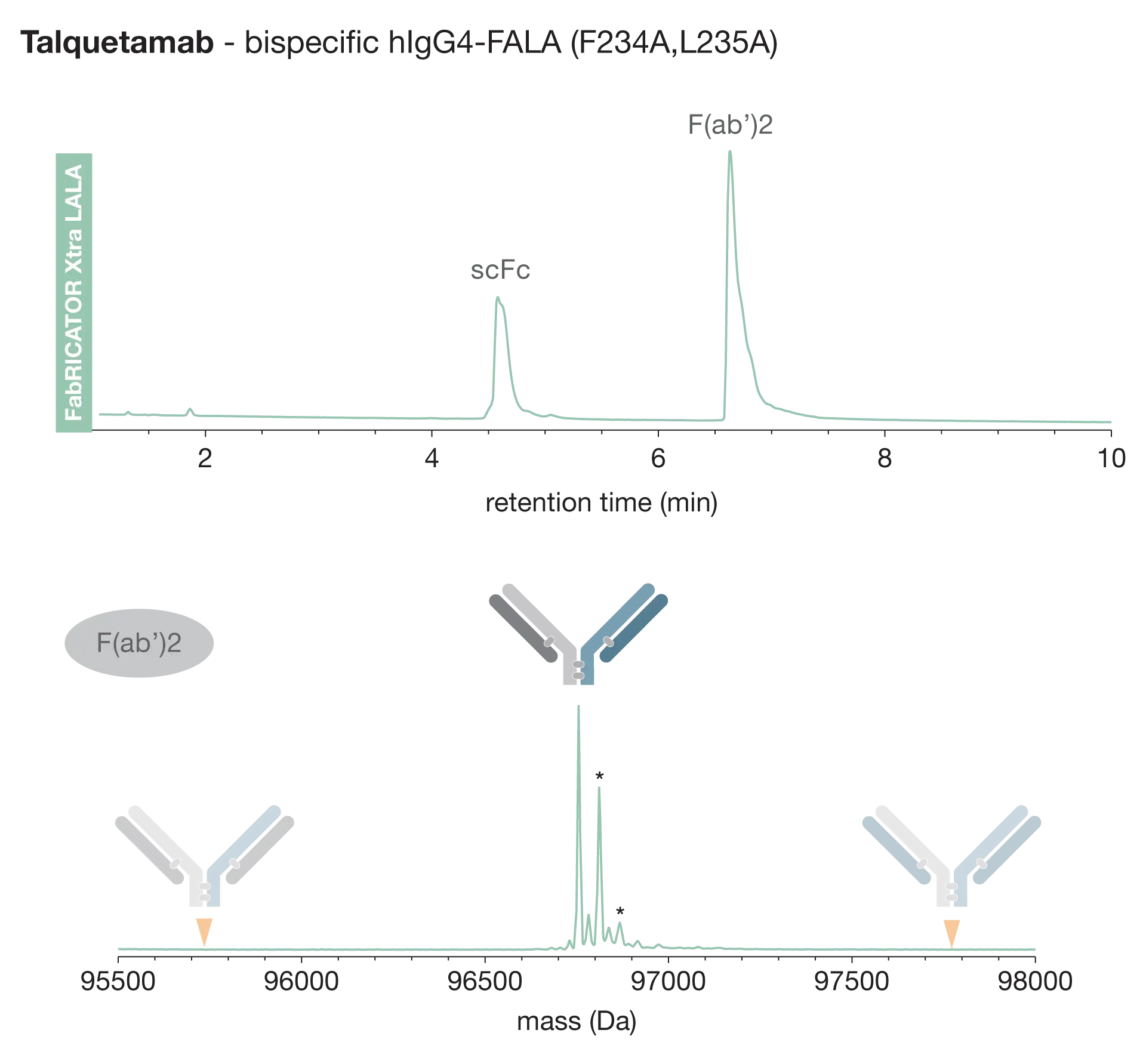
Here, we demonstrate analysis of a bispecific human IgG4 antibody, talquetamab, which contains the Fc silencing mutations F234A and L235A in the lower hinge. FabRICATOR Xtra LALA efficiently digested this antibody into scFc and F(ab’)2 fragments which were easily separated by reversed-phase chromatography. MS analysis of the F(ab’)2 fragment demonstrates correct assembly of the bsAb and the absence of any chain pairing-related impurities.
Efficient digestion of FALA-mutated bispecific human IgG4
Demonstrates correct assembly of bispecific molecules
Lyophilized enzyme for below hinge digestion of up to 2 mg of hinge-mutated IgG
Download Product Folder
