Native-state Antigen Release by AlligBAITOR™ Lyophilized
Application
Native antigen release from antibody-antigen complexes, enabling downstream functional, structural, and biological characterization of otherwise hidden targets.

Native-state antigen release is critical when preservation of antigen structure and biological activity is required for meaningful downstream analysis. Access to intact antigens enables functional characterization, epitope mapping, and confident identification of biologically relevant targets. This capability is particularly valuable in biomarker discovery, where circulating immune complexes can mask clinically important proteins, as well as in vaccine and infectious disease research, where native antigen structure is essential for accurate characterization of immune responses. In autoimmune disease studies, native antigen release can facilitate the identification of full-length autoantigens and conformational epitopes associated with disease pathology.
Conventional antigen release methods typically rely on denaturing conditions that can alter antigen structure and compromise downstream analyses. In contrast, AlligBAITOR enables the release of antigens from antibody-antigen complexes under native conditions, preserving antigen integrity and expanding opportunities for functional and translational research. Here, we demonstrate native antigen release from pre-formed antibody-antigen complexes using AlligBAITOR under physiological conditions.
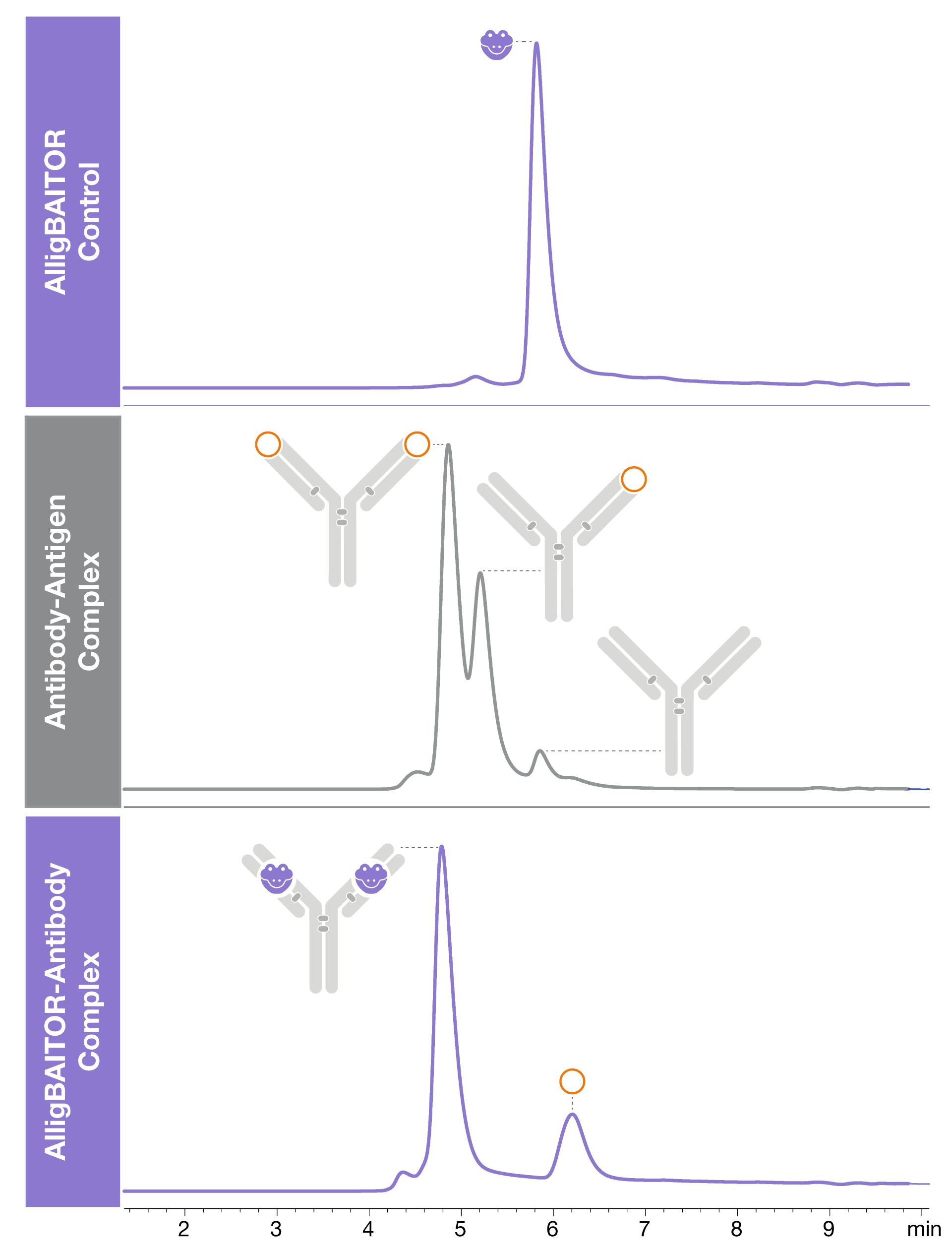
We showcase the function of AlligBAITOR using the well-characterized antibody-antigen pair Trastuzumab-HER2. A defined Trastuzumab-HER2 complex was first generated by incubating the antibody and antigen in PBS for 30 min at 37°C. Subsequently, AlligBAITOR Lyophilized was added and the mixture was incubated for an additional 30 min at 37°C. Samples were then analysed by size-exclusion chromatography (SEC) which confirmed formation of the trastuzumab-HER2 complex. Following addition of AlligBAITOR, the signal corresponding to the antibody-antigen complex was replaced by a new species consistent with the trastuzumab-AlligBAITOR complex, accompanied by release of free HER2 antigen.
AlligBAITOR facilitates native-state antigen release
These observations support a mechanism by which AlligBAITOR binds in a defined stoichiometric manner, with one AlligBAITOR molecule engaging per heavy chain, independent of antigen occupancy, and remains stably associated. Therefore, AlligBAITOR is consumed during the reaction, and the extent of antigen release is expected to depend on the available antibody concentration. In this IgG model system, antigen release is demonstrated using trastuzumab-HER2 as a representative complex; however, AlligBAITOR functions as a pan-Ig binder and is expected to exhibit consistent activity across antibody isotypes.
Disruption of antibody-antigen complexes across antibody isotypes
These results highlight the unique capability of AlligBAITOR to convert antibody-antigen complexes into free antigen and stable antibody-AlligBAITOR complexes. Fully compatible with complex matrices such as serum, AlligBAITOR enables simple pre-treatment of samples to unmask immune-complexed antigens, unlocking analytes that may otherwise escape detection and expanding the potential of downstream functional analyses.
Unmasking of clinically relevant proteins in complex samples, such as serum
Related Products
Resources
AlligBAITOR™
Download Product Folder